
Betty Crocker and Broken Kids
Chocolate frosting, an ABC After School Special, and the girl I almost wanted to become.

At 11, I watched a sarcastic foster kid on TV and thought she was fearless. Nearly 50 years later, I finally understood what she’d given me.
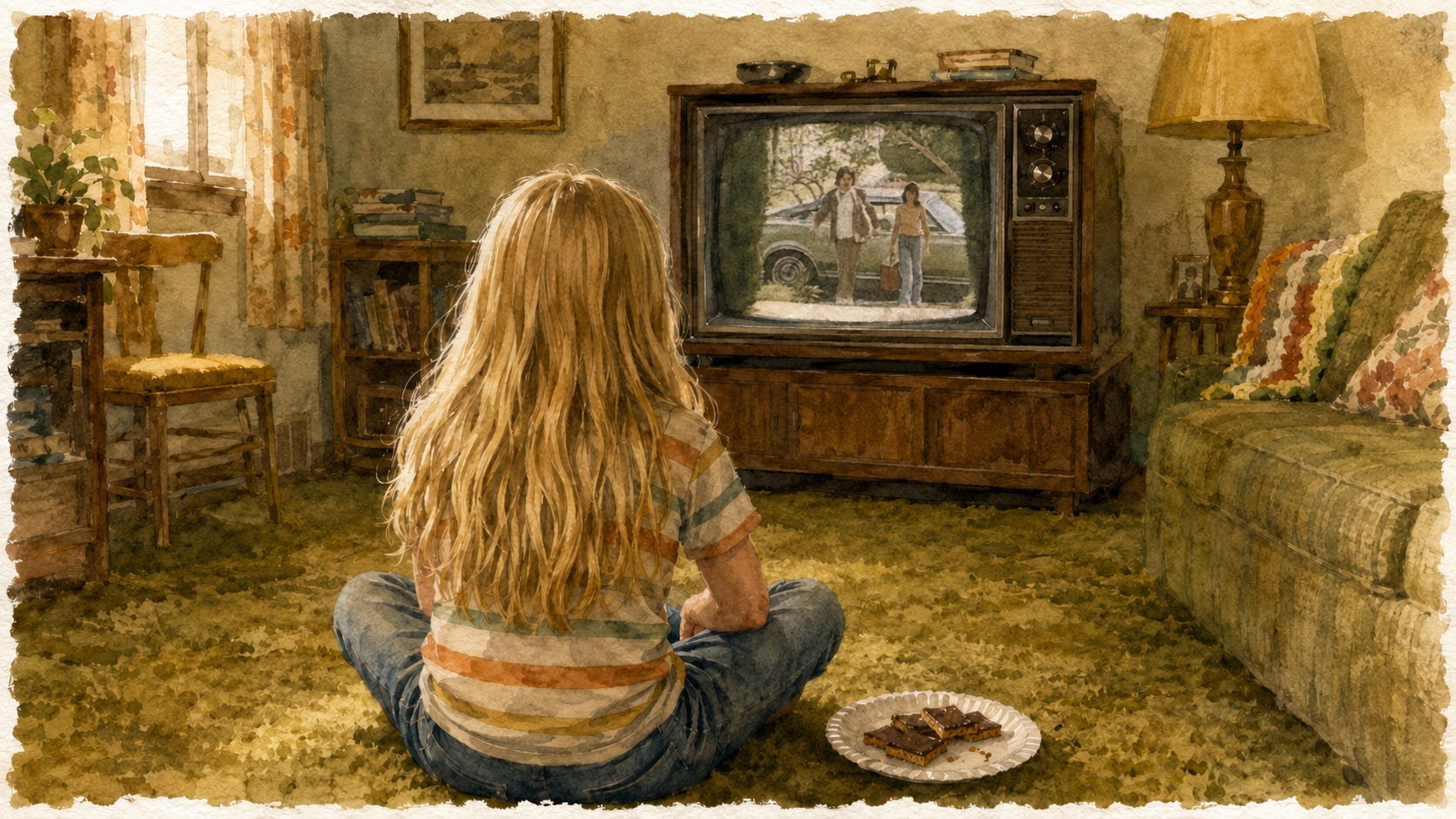
I sit cross-legged in front of the TV. Mom bought some Betty Crocker frosting, so I’ve whipped up my favorite snack—a paper plate laden with chocolate-frosted graham crackers. It’s time for the ABC Afterschool Special.
Amazingly, I’ve got the living room to myself. Dustin, the baby, is asleep. Scott and Dad walked down to the lake. Mom’s starting dinner. Finally, I’ll be able to concentrate on the show.
On the screen, a huge green car pulls up in front of a house, and Kristy McNichol climbs out the passenger side. She’s my favorite! She plays Buddy on Family, and now she’s starring in this new Afterschool Special episode, The Pinballs.
I’m rapt as Kristy, who plays a girl named Carlie, enters her new foster home and immediately starts being a total jerk. She’s sarcastic to the core, and she doesn’t seem to care what anyone thinks. She quickly scouts out her foster family’s TV and settles in for a soap opera.
Kristy McNichol’s Carlie is the coolest girl I’ve ever seen. She doesn’t hold things back like I do—when people are acting up (and even when they aren’t), she lets them have it. What would it be like to just speak your mind like that, to not quietly hold every feeling inside, to be unafraid of how people would react?
What would it even feel like to be angry and just let people know about it? I could never be like Carlie, but I desperately wish I could. I try practicing a few times. Once, when my little brother Scott is teasing me relentlessly, I even lose my temper. I put a hand on each of his shoulders and bring my knee firmly up into his groin. He doubles over in pain.
“I’m sorry! I’m sorry!” I cry, and I run away. I carry the fresh memory of what I’ve done for months, riddled with guilt.
* * * *
Peter stands before me in our bedroom, hands on his hips, red-faced and leaning in toward me menacingly. This used to intimidate me, but now I’m reminded of the nature documentary I’ve just watched with the kids, where a tiny jumping spider reared up and waved its front legs like it was about to throw down. The kids and I laughed at the tiny creature: “Ooooo! Scaaaawy!”
I put my hands on my hips, too, and I don’t flinch. My husband has, inexplicably, found a gold cufflink shaped like a treble clef on the floor of our bedroom. And I can honestly say I have no clue where it’s from or how it got there. So, of course, my husband is convinced I must be having an affair with the director of the community choir I belong to. Especially now that I’m secretary of the board and we meet at Sherman’s house monthly.
“You mean to tell me this just showed up, Karen?” He wields my name like it’s a weapon. (And this is long before the name Karen became a social media phenomenon.)
“Yes, that’s exactly what I mean to tell you.”
He leans in, sneering in my face. “Why should I believe you?”
I’m done with this. I’m done defending myself, because there’s nothing to defend against.
“You know what?” I say. “I’m not pulling my punches anymore.”
“Oh, really? What’s that supposed to mean?”
“You want a reason to believe me? Let’s start here: I’m not trying to sleep with every man I meet. But I can absolutely see why you’d think I would, because hey, it’s what you’d do, right?”
Peter glares. And I know this look; it’s the one that might precede shouting, shoving, backing me into a corner, preventing me from leaving the room. But Peter’s less fit than ever, our kids are almost grown, and I’ve got nothing left to lose. So when Peter snarls that I’m pushing my luck, I don’t back down. I double down.
“Patty, Virginia, Patricia the Second, Victoria, Susan…”
Peter dramatically clutches his chest with each name, as though I’m stabbing him through the heart.
“How could you say those names?” he gasps. “Are you trying to hurt me?”
A dry, sardonic laugh escapes me. “Do you even hear yourself? You’ve become ridiculous.”
“Ridiculous?!” His face registers cartoonish levels of outrage.
I shrug, shaking my head as I walk away. Unlike in years past, Peter doesn’t try to block the door. He doesn’t grab my arm, leaving a hand-shaped bruise. Instead, he lets me go. I feel a newfound power surge through me, one I’ve exercised for the very first time. After years of fooling myself into believing I could save him from himself, I’ve come to accept that Peter is exactly who he is, and nothing I can do will ever change that.
And I’ve started to realize that I can no longer accept Peter.
Months later, when my grandmother succumbs to pancreatic cancer at 94, I ask Peter to read a eulogy I’ve written at her funeral. I was close with Little Grandma, and we’d even lived with her for a time after Gramps died. I know I won’t be able to contain my emotions if I read the eulogy myself, but Peter is a skilled orator, so I’ve asked him.
I’m emotional as I make dinner the night before the funeral. I snap at Peter and, inevitably, we get into a fight over something small that gets blown so far out of proportion that suddenly we’re in the kitchen shouting at one another.
If my anger is an ember quietly glowing, what Peter says next is the iron poker that prods the log and causes it to flare into a roaring flame:
“You can get someone else to read for your grandma’s funeral, bitch!”
I’m standing over the sink straining spaghetti when he says it. Without a word, I pick up the plastic spaghetti spoon and hurl it at his head. Like George W. Bush famously dodging a shoe, my husband also has surprisingly good reflexes. The spoon clatters to the floor. Peter stares at me, mute, his mouth open.
There is no question I mean what I say next. The voice I summon rises from low in my chest, rumbling out:
“Get the fuck out of my house!”
And because I own the house on a land contract, because it’s my name on the deed and Peter has no legal right to it, that’s exactly what he does.
* * * *
I sit with my leg elevated, still recovering from a broken fibula. Though the cast is off, the leg aches, reminding me I’m alive.
I’m bored by the inactivity, but my curiosity is piqued. I naturally lean toward curiosity, and for reasons I can’t even trace, suddenly I’m tugging at a long-lost thread and searching for The Pinballs. It’s something I carry a strong memory of from childhood. It must mean something, right?
I’ve forgotten much of what the story was about. I remember cool Kristy McNichol, of course, and how much I admired Carlie. I remember the story is about a mismatched group of kids in a foster home. Beyond that? I’ll be seeing it with fresh eyes.
Carlie and a CPS agent (who’s never actually called that, but as an adult I get the gist) pull up in a 1970s sedan the size of a yacht. The earnest agent introduces Carlie to her new foster mom. Carlie immediately starts in with the witty repartee.
“And this must be Carlie!” says the sugar-sweet foster mom.
“Well, it’s not exactly Helen of Troy,” quips Carlie.
The two women smile and nod at each other with raised eyebrows. Oh, that irrepressible little rascal, Carlie!
But nearly 50 years later, I can see what I missed when I first watched The Pinballs and chose Carlie as my hero.
Carlie wasn’t fearless. She wasn’t even being herself. The sarcasm I’d thought was so impressive and honest as a child was nothing more than a mask protecting a frightened girl who’d learned to fire shots at people before they could take aim at her.
But Carlie had also given 11-year-old me a gift. She’d shown me that buried beneath all that snarky meanness was something I’d needed: permission to be angry. Permission to stop smiling through my pain, cushioning every blow by simply absorbing it. Permission to stop making myself easier for people and start being someone who demands to be seen.
Carlie wasn’t exactly free—she was still a teenager living with a foster family, still the survivor of an impossible childhood. But she’d shown me the shape freedom could take. She’d shown me the difference between letting anger build another kind of cage and finding the freedom that lies in truly becoming yourself.
Lessons that we all should’ve learned so much earlier, but did. But at least many of us are learning them later in life……