

We carry our folding chairs and snacks out into the darkening field. Ian and Shayla chatter with one another, an excited sibling banter, and Mom looks to me for our strategy.
“Let’s get somewhere toward the middle and near the back,” I say. “Easier to get out when the show’s over, and we’ll have a great view without straining our necks.”
“All I care about is the noise,” Mom says with childlike excitement. I can never quite tell if that childlike demeanor is affected or genuine. “Let’s make the noise!”
“I like the colors!” Ian says.
“Me too!” Shayla confirms.
“Not the noise? Are you actually your grandmother’s grandchildren? Are you sure?” Mom teases.
Ian snatches her hand. “We like noise, too, Grandma!” Always appeasing, that kid. Down the road, he’ll evolve into a first-class people-pleaser just like his mom. But he’ll also be a kind, lovely, socially aware and emotionally mature man. A mom could do worse.
We situate our chairs and ourselves and wait, people-watching as the night grows darker. We discuss, as we always seem to, how the Bartolotta folks—the renowned Southeastern Wisconsin pyrotechnics company putting on this show—seem to loosely define the “dusk” part of “fireworks at dusk.” Mom and I ask one another what the fireworks are even celebrating. Some sort of anniversary for the tiny town of Nashotah, but what?
“Do we really care?” I laugh when we don’t arrive at a satisfying answer.
Mom shakes her head and shrugs. For her, fireworks don’t need a reason. But little Shayla adds earnestly, “I do. I care.” And that kid will develop a real taste for history trivia while blossoming into an opinionated-but-caring human with a thirst for learning new things, a strong bent toward social justice, and … well, a mom could do worse.
And then… Foomp! … Boom!
The warning firework signals that the show is about to start. People who’ve been milling about return to their blankets and lawn chairs. Fireflies blink in the distance. It’s late summer in Wisconsin—humid air, whiny pests, and an insect chorus that drowns out practically everything except—
Foomp! … Boom!
The show begins, and we watch raptly, joining the crowd: Oooo! … Aaaah!
And then, after about 20 minutes of razzle dazzle, the show just seems to end. Mom and I look at each other, equal parts puzzled and annoyed. What? No grand finale? What a bust!
Then Ian points to some figures emerging from the shadows. Three men, each with a signal flare in hand, spaced equidistant across the front of the field that’s been cordoned off for the pyrotechnicians. On some cue we can’t hear, they begin to march forward in sync, flares raised. They arrive at their destinations, lower their flares in unison, and skip away quickly before—
All hell breaks loose!
The sky fills with explosions from three different stacks of powerful fireworks. Colors light the night, shimmering across our faces and lighting our eyes in vibrant fuschias, blues, greens, and golds. Despite the cacophony of booms, Mom’s whoops of delight spur us on, and soon we’re all shouting and cheering and laughing. It’s literally the noisiest, most colorful grand finale we’ve seen, not just all year but ever.
As we make our way back to the car—my easy-exit strategy worked like a charm and we’re a few steps ahead of the surging crowd—Mom seems to vibrate with excess energy. She grabs my hand urgently and leans in, thinking she’s talking into my ear.
“That was so good I almost came!” she barks loudly, to the snorts and chuckles of surrounding people who are also trekking to their cars.
I laugh. “Really, Mom? Really?”
“What?” she says, giving my arm a playful tug. “Fireworks are better than sex!”
I like fireworks, but I beg to differ. Still, I don’t say anything to dampen her excitement. It’s best to let Mom just keep buzzing away while the spirit moves her.
* * * *
Mom dropped a revelation on me one day as we sat at her dining room table.
“When I was pregnant with you, I wanted to be a single mom,” she said. “But you know your grandmother. She would’ve had a stroke.”
She’d told me about getting married at 18. She’d worn a blue dress my grandmother picked out, and it had been a quick and simple affair because she was four months pregnant with me. I knew she’d hated how she got married, but not that she hadn’t wanted to get married at all.
Mom had been complaining about Dad’s latest money-making enterprise. He’d planted several acres of strawberries on their sprawling farm. As the berries ripened, he demanded they be tended. By anyone but him.
“Imagine! If I’d stayed single, I wouldn’t have to get up at 6 a.m. on a Saturday to pick berries so your dad can go schmooze at the farmers market,” Mom said. She already worked a 40-hour week in the back office of the local Walmart.
“Why can’t he pick the berries himself?” I asked.
It was a rhetorical question mostly meant to commiserate. After the initial thrill of planting the berry patch faded, Dad’s self-appointed role was to wander the field looking for issues he felt like tackling. Grabbing a .22 and shooting grackles — blackbirds who loved to peck the strawberries — was a problem he’d eagerly remedy while singing, “Kill the grackle … kill the graaaaaaaackle!” in his best Elmer Fudd voice.
But weeding? Harvesting? Those things were someone else’s problem. And because we kids were grown and leading lives of our own, the weeding and harvesting fell to Mom. She looked tired.
“You know,” I said gently, “You could tell him you don’t have the energy to pick berries after working all week. He’ll just have to take care of it himself.”
“You know he won’t. And then what? I get to listen to him blame me for his crop rotting in the field?”
I’d been reading up on codependency. My own marriage was rife with it, and I was desperately trying to learn how not to enable my husband’s lying, cheating, abusive behavior.
“You don’t have to accept the blame,” I said. “What if you just said no? What’s the worst that could happen?”
“He’d be broke and rummaging through my purse for bar money. I can’t afford that. Who’s going to pay the bills?”
I had no answer. I hadn’t gotten to the “What to do if your partner steals from you when you refuse to enable them” chapter of Codependent No More.
Mom and I sat in silence for a while as she gazed out the dining room window at the offending strawberry patch. Finally, she pushed herself away from the table and rose slowly to her feet.
“Guess it’s time to make dinner. You know how your dad gets.”
Yes, I knew. I’d witnessed the scene over and over throughout my childhood. Dad would tumble through the door at around nine or ten and head directly to the microwave. The remains of the evening’s dinner would be waiting inside, already covered in cling wrap, ready for him to heat up. The routine was so familiar that our African grey parrot, Gatsby, had learned to perfectly imitate the sound of Dad’s footfalls, the beep of the microwave, and the slam of the microwave door.
If Dad came home giggly — we called this the Tee-Hee Phase — all would be well. If he was sullen, he might end up ranting and raving in his strident, tenor voice about some imagined slight before skulking off to bed. No one would get hurt, but everything about the day would suddenly get worse.
Knowing that, I couldn’t bring myself to tell Mom that setting out dinner was enabling, too. On the drive home, I wondered, as I had many times, why she continued to put up with it.
* * * *
I remember the frigid February day with cruel clarity.
I’d just come back from driving the kids to school in the wake of a heavy snow. The roads were treacherous but passable. I‘d fixed myself some coffee when my phone rang. It was my youngest brother, Dustin.
When I answered, all I heard was frantic breathing for a moment before Dustin gasped, “Sis, I need you! Maria’s giving Mom CPR.”
“What?” I cried. I didn’t take the time to ask questions; from the sound of my little brother’s voice, I knew — it was bad. “I’m coming! I’m on my way!”
I drove recklessly through the frozen countryside, sliding several times but always managing to stay on the road. I arrived to find an ambulance in the driveway in front of Mom and Dad’s little blue house.
Dustin ran to me and wrapped his arms around me. “She’s unconscious,” he said. His vacant eyes stared past me to where EMTs were loading a gurney into the ambulance. “She just … passed out. I couldn’t wake her up.”
I learned that Mom had called Dustin, who lived across the driveway on my parents’ property, asking if he’d let her dogs out because she was too sick to get out of bed. When he checked on her, she could barely breathe. She looked up at him and uttered what would be her last words:
“I think I’m dying.”
Dustin had frantically called for his wife, Maria, a surgical assistant. She gave Mom CPR for nearly 30 minutes until the ambulance arrived.
We followed the ambulance to the hospital. As we awaited word, the three of us pacing around a large, open solarium, I suggested someone call Dad. He was in Florida, where my parents had bought a rundown double-wide trailer on a spot of land in Homosassa to fix up.
Maria offered to call. She and Dad inexplicably had a better relationship than he had with any of us kids. I listened as she explained that Mom had lost consciousness and was being admitted to the hospital.
At one point, Maria cupped her hand over the phone receiver and looked at me. “He wants to know if he should come home,” she said.
“Of course!” I snapped. Was Dad so self-involved he couldn’t see that his unconscious 65-year-old wife being admitted to the hospital was an emergency?
Dad made it home in time to say goodbye.
Our family — now including my brother Scott, who’d flown in from Colorado — had been tended to and informed by a kind, soft-spoken, rheumy-eyed nurse. After we watched frantic doctors and nurses revive Mom with a defibrillator many times, with her never once gaining consciousness, he came to us.
“It’s time to make a decision,” he said to Dad. “We will absolutely continue life-sustaining measures if that’s what you want us to do. But…”
The nurse looked at me. He saw how wrecked and despondent my father was, and I believe he realized who the real decision-maker would ultimately be.
Mom didn’t have an advanced directive, but she had me.
“Dr. Olsen says, at this point, Mom’s brain has been without oxygen long enough that it’s very unlikely she would have a good quality of life even if she did wake up.” He placed one hand on Dad’s shoulder and the other on mine. “Do you want us to continue lifesaving measures?”
Dad looked at me. “We do … don’t we?” His small, plaintive voice wove itself through my nerve synapses, sending a surge of empathy to my heart.
How could I say what I had to say? I remembered all too well the conversations I’d had with my mom about death. “Don’t keep me alive with machines,” she said. “I don’t ever want to be a vegetable.”
“We do not,” I said softly, shaking my head. “She wouldn’t want that. She would want us to give her peace.”
And so, less than 24 hours after she was admitted to the hospital, we watched as nurses unhooked the machines that kept Mom’s heart beating and lungs breathing. We watched as her chest rose a few more times and then ceased to move. We each took a turn saying goodbye.
As I leaned in to kiss her rapidly cooling cheek, I whispered, “I love you, Mom. Rest now. You’ve earned it.”
* * * *
Dad unraveled after Mom died.
Without her to clean up his messes, the house quickly filled with clutter. With no one to prepare meals for him, he took to grabbing a sandwich from the local gas station. He forgot to drink water and ended up in the hospital with severe dehydration more than once.
Mom was codependent no more, but her dependent was lost without her.
While Dad fell apart, I found myself lingering on the simple refrain Mom repeated after every summer fireworks show’s grand finale. When her shouting and applause had faded, she would turn to me and exclaim, “When I die, put my ashes up in a firework!”
And so, when summer arrived, Scott helped me make Mom’s wish a reality. He arranged for some of her ashes to be placed in a firework that would be shot off during a July 4th show over Silver Lake. We were told the grand finale would happen, followed by a brief moment of silence. Then, Mom would take to the sky as a single golden willow.
I sat on the pier with Dad, watching the show. Despite all the light and noise, Mom’s gleeful whooping was glaringly absent. I nudged Dad’s shoulder with my own and said, “Mom sure loved this stuff.”
“I never understood it,” Dad said. I bristled. Even now, it was all about him. What he understood. What he found comfortable.
“We went to a show in Nashotah a few years back,” I said, ignoring his comment. “When they got to the grand finale, three guys with torches walked out into the field and lit three separate displays so they’d all go off at once. It was amazing — total chaos. You know what Mom did?”
Dad shook his head, looking up as a big red chrysanthemum exploded overhead.
“She grabbed my hand and shouted, ‘That was so good I almost came!’”
Dad snorted. “She said that?”
“In front of the kids, God, and everyone,” I said.
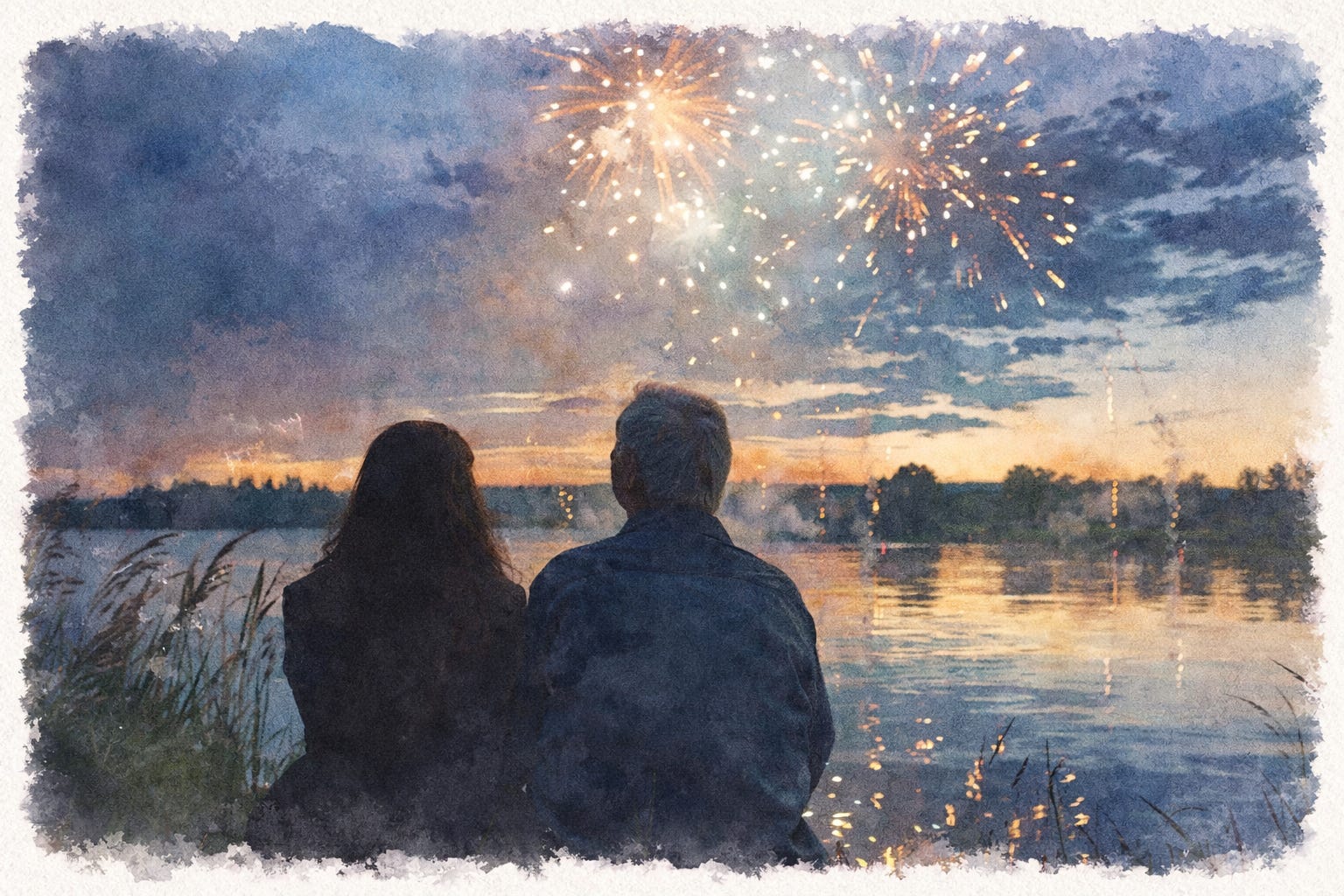
Just then, the Silver Lake grand finale began with a barrage of booms and a blaze of sparkling lights and colors. Dad rose and stood at the edge of the pier, his hand over his heart, face turned skyward. Colors illuminated his white-blond hair.
Then, silence descended. Dad’s frail, thin voice rang out across the water:
“I love you!”
Foomp! Sparkle! Boom!
Beautifully crafted, Karen <3