

This week’s story is two days late—for reasons you’ll understand by the end of the tale. Thanks for being here! ~Karen
A spring day in 1995. I’m 28, with my 9 month old son Ian slung on my hip. It’s a sunny and warm afternoon, and I’m excited to go out and run errands, to see the snow piles in parking lots turning to puddles, purple crocuses dotting lawns, leaves budding and ready to turn the whole world green.
Then my foot lands on a jacket that’s fallen off the coat rack onto the steps. Suddenly, my left leg is unexpectedly sledding down a flight of carpeted stairs, and my right leg curls up under me and … snap!
I literally hear the sound, like a brittle twig broken beneath a stomping hiker’s boot. The pain is instant and fierce. I let out a cry as Ian, still clutched in my arms, looks at me quizzically.
This is bad. I have to get to the phone.
I steel myself and slowly butt-walk up the stairs. Each butt-bump brings fresh tears as pain surges through my body. But for Ian, each butt-bump brings laughter—to him, this is a curious little game we’ve never played before.
“Mommy’s hurt,” tell him through gritted teeth. He smiles at me, eyes full of recognition and love.
Finally, we reach the top. When we’re far enough away from the stairs, I scootch myself across the carpet, across the living room, to the phone. I dial my husband’s work number.
“Ernie von Schledorn Auto Sales; this is Peter.”
“I need help,” I wail. I’m shocky and hyperventilating now, trembling as Ian, still on my lap, looks at me with concerned eyes. “I fell on the stairs. I hurt my leg bad.”
“Kayly, you know I can’t leave work,” he says in a clipped, impatient tone. “Kayly” is the nickname he gave me when we were dating because my real name apparently wasn’t good enough.
I look down at my ankle and see blood and a gleam of white.
“I think my leg is broken,” I cry. “There’s bone poking through my skin!”
Peter sighs heavily. His is a language punctuated by long, exaggerated expulsions of air meant to express frustration and intimidate anyone tuned in to his explosive moods.
“How did this happen?” he asks.
“I slipped on a coat that fell off the rack,” I gasp. How does that matter now? “I need help!”
Peter ends up not coming home. Instead, he calls our neighbors, Steve and Julie, whose children I babysit. Steve calls an ambulance, gets the super to unlock our coach house apartment door, and waits with me. The EMT’s come, and Steve holds Ian as they brace my leg and strap me to a gurney. Then, when they’re ready to whisk me away, my son lets out a plaintive cry. I turn my head to see tears streaming down his face as he reaches for me, hands like tiny anemones waving in a current of emotion.
I broke my right tibia and spent long, terrifying hours in the ER getting painful X-Rays and having a cast put on. Peter arrived just as I was getting final care instructions. He performed concern—and in fairness to him, when he saw just how serious things were, his concern was as legitimate as it could be for a man so lost in his own dysfunction. The doctors deferred to him as they provided care information, all while I knew that the only people I could rely on for real help were my mother and grandmother, who lived a half hour away from us.
* * * *
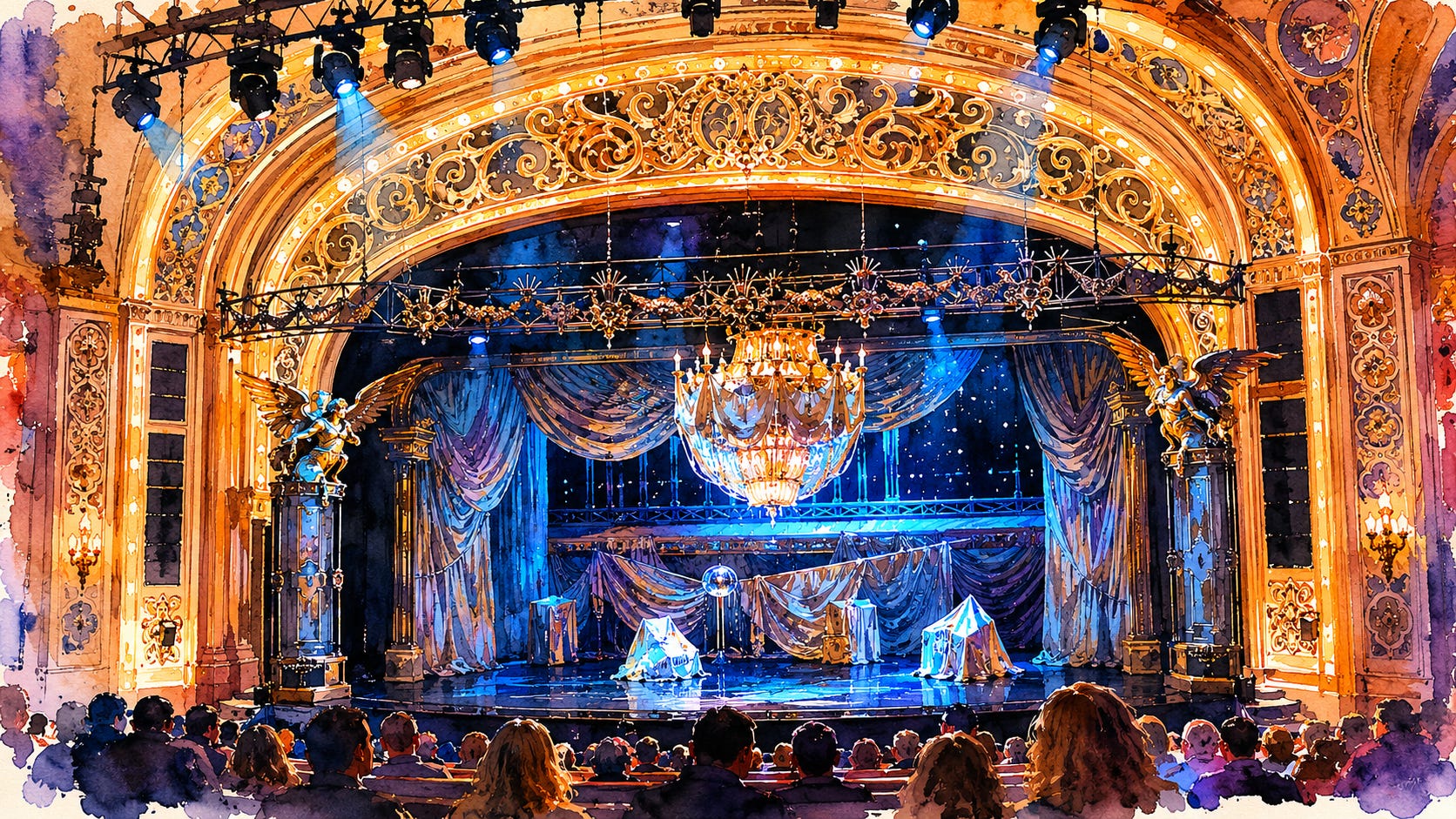
A late-spring evening in 2026. I’ve recently turned 60. I’ve long since cut all ties with Peter and moved 2,000 miles away to the Pacific Northwest. I’m struggling financially since I was laid off from my corporate job and struggled to find work in a market heavily hit by AI, but tonight I’m having an exciting little date night with my daughter, Ra. It’s the eve of their 29th birthday, and they've bought us tickets to Phantom of the Opera at the historic Paramount Theater.
Inside the sprawling building, we climb three flights of stairs, and then another shorter flight to the mezzanine level. We take our seats, but the people in our row seem determined to play a game of musical chairs, forcing us to stand in the aisle and let them go in, and out, and in, and back out in what seems like an endless and exhausting rotation. Not during the show itself, but before it begins, and during intermission.
And every time I stand to let them in and out, I’m reminded of how unstable I am on these stairs. I have nerve damage from osteoarthritis that extends to my feet, where I have diminished feeling. I’m constantly aware that my balance isn’t what it used to be.
And the Paramount has strange, uneven stair treads. Not only that, but in the seating area, there are no hand railings I’ll be able to steady myself on as I descend these stairs. I give myself an inner “you got this” motivational speech. I’ve done it before, I tell myself, and I’ll do it again. No problemo!
When the curtain call happens, I nod at my daughter. They know the drill—we bug out early to avoid the rush. As much as I love a good curtain call, I also get anxious to the point of panic in crowds. I’m getting better at managing it, but hey, why tempt fate?
I make my way down the stairs at a slow pace. I’m not going to tempt fate in that area, either. But the lack of handrails feels so …
My left foot hits the edge of a carpeted stair tread—I literally feel it when it happens. My foot flies out, my right leg folds under me, and I’m down, sliding down three or four stairs. I lie there for a moment getting my bearings. What happened?
I hear my daughter behind me say, “Mama!” and people seated nearby saying, “Are you OK?” I hear myself answer, “I don’t know…”
Fear and adrenaline take over. I grab the railing (here they have a railing, enclosing the seats) and pull myself to my feet, wincing in pain. Ra asks, their face a mask of worry, whether I can make it down the stairs. I clench my jaw in determination and answer: “I have to.”
Yes, we could have called for help. Yes, I could have been carried out in some way. I’ve even heard that the Paramount is equipped for just this thing. But I’ve spent a lifetime figuring out how to do things for myself, and I’ll be damned if I’ll suffer the embarrassment of being lifted out when I can walk.
Also, curtain calls don’t last forever and my fear of being crushed under a stampede of theatergoers is real.
I navigate down the stairs in a blur, hobbling and grimacing. People turn to gawk. I ignore them—I’m singularly focused on getting to the bottom of four flights of stairs. When I finally reach the ground floor, I tell Ra that there’s absolutely no way I’ll be able to walk to their car, which is parked in a garage up a steep Seattle hill.
An elderly man and woman pull up next to me and the woman takes a seat on the bench beside me. “I’m just finding a seat for my wife,” he says, smiling. I try to smile back but shock has set in. I’m shivering and unable to focus.
“I got hurt,” I manage to say. “I fell on the stairs. I’m waiting for a ride from my daughter.”
The man turns to his wife, who’s literally sitting right next to me. “She fell on the stairs!” he says. “She’s waiting for her daughter!”
The woman smiles, not without some concern. “Always an adventure here,” she says kindly. “I have neuropathy.”
“Me too,” I answer, shivering.
“She has neuropathy, too!” says the man. ”Are you able to walk to the curb?” he asks. And I wish—oh, I wish—he would just leave me alone. I can’t pay attention to him right now. I’m just trying to hold myself together with rubber bands and duct tape.
“I don’t know,” I answer.
He turns to his wife. “She doesn’t know if she can walk.” The woman turns and shoots me a sympathetic smile.
To his credit, the man goes to the theater staffer standing at the exit doors and asks if the little wheeled chair—not quite a full-on wheelchair, but clearly some sort of mobility aid—is for public use. The theater worker comes over and gets it set up for me. As he does this, I learn that the tall, bearded man’s name is Eric. As a Phantom of the Opera nerd, I know that Erik is the Phantom’s chosen name in Gaston Leroux’s gothic novel, and his unspoken name in Andrew Lloyd Webber’s production.
But this Eric is no Phantom. He calmly gets me to the curb as I profusely apologize for putting him out. “It’s what we’re here for,” he tells me, his tone friendly and kind. Finally, Ra’s little Prius pulls up to the curb, Eric helps me get into the car, and we set sail.
I turn to Ra: “I think I need to go to the ER.”
A few hours later, at about 2 a.m., I butt-walk up the four stairs to our humble little house, let out an agonized war whoop as I pull myself to a stand, and finally manage to crawl into bed, thoroughly exhausted and wearing a temporary splint. I have a fractured fibula. Additional X-Rays at the orthopedist a few days later will also reveal a “high ankle sprain,” which I’m told is notoriously slow to heal.
So, that’s fun.
But I’m managing. Despite all of the logistical challenges, not to mention the complete rewiring of one’s nervous system that comes with suddenly losing mobility and independence, I’m in good spirits. Ra and I laugh when I adjust the covers and accidentally flash parts of my anatomy my kids were never meant to see. We figure out home mobility aids together (expensive), and Ra assembles a knee scooter (because why are we still using the same medical device Tiny Tim used?), then a tub chair, and another chair with offset legs to help me navigate those four evil stairs up to the house just a bit easier.
Ra doesn’t just assemble things. They cheerfully assist me with… everything. They cook dinner, deliver food, clean. They apply for family medical leave. And after that, they fix the dislocated mower deck belt on our old Craftsman lawn tractor and mow the lawn. I’m filled with love and pride watching them step up while hating being the one who forced this burden on them.
We keep our good humor as I announce to my friends that I biffed it but good at the Paramount (and that I feel like a badass for getting hurt in the line of musical theater duty, considering I’m a musical theater singer myself). I cancel the joyful, always-anticipated classic rock and folk song circle I’ve led for the past seven summers.
And that’s when the messages start coming in. Friends want to deliver food, with no expectations of coming in to see me during such a high-stress time. Becky shows up first with an entire tray of lasagna and, because my beautiful daughter turned 29 in the ER with me (we’d been going to see Phantom in part to celebrate their birthday), an ice cream cake, which has always been our traditional birthday treat. Then Andy delivers three little trays of chicken enchiladas, perfect for freezing to reheat when we need them. Donna emails to offer food. Meggin drops off a lentil stew and naan bread, plus gifts and some treats for the dogs.
Then the garden fairies show up.
Since 2022, my life has felt like one long endurance test. And, true to my “I’ll figure it out,” eldest child, Gen-X, parentified roots, I cheerfully powered through every roadblock. Not without late-night panic attacks, but with stubborn persistence nonetheless. My life literally became a years-long meme:
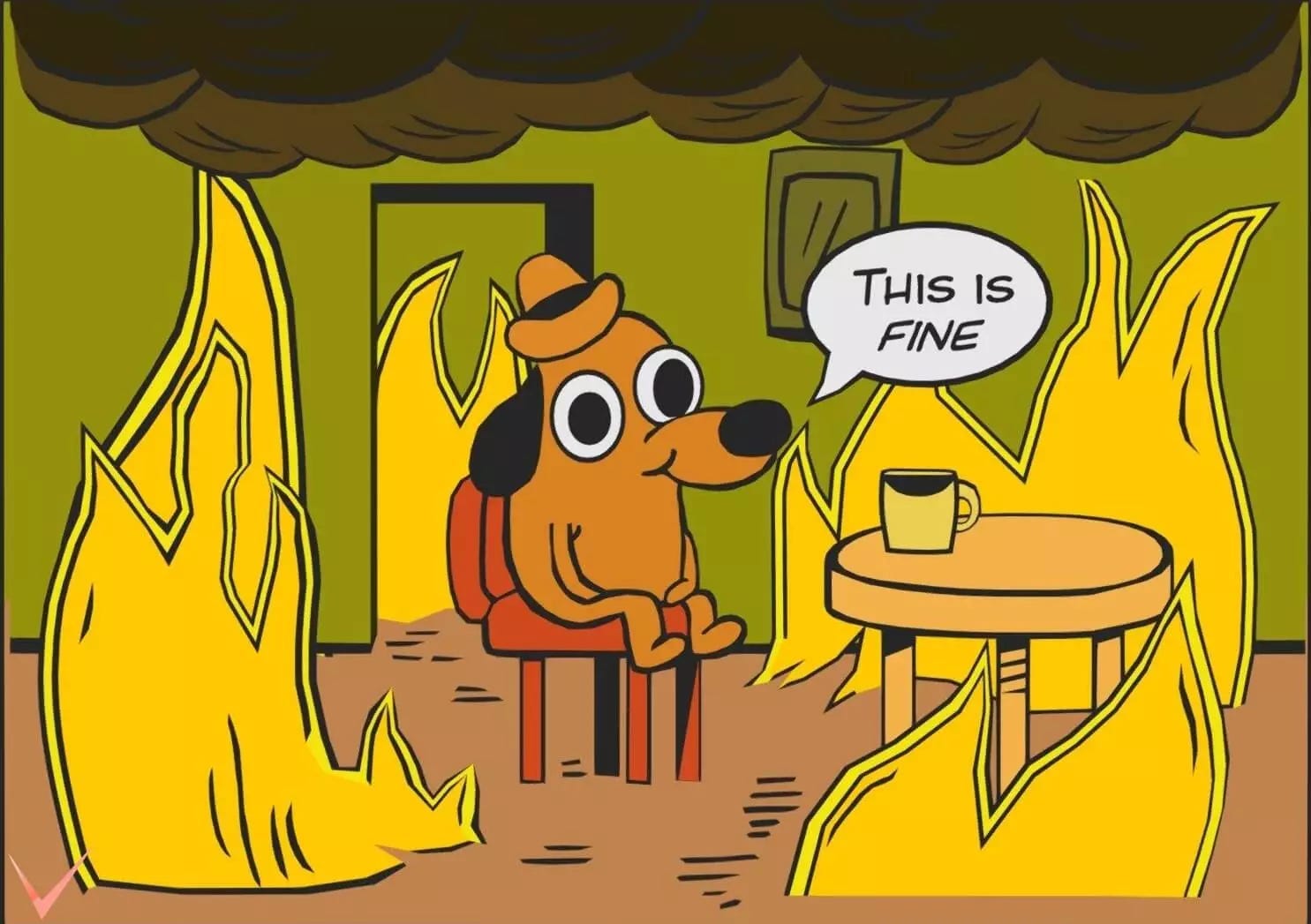
And over those years, slowly and insidiously, my home and yard started showing the strain that comes with a person who’s trying to process a little more than humans were intended to process: the death of my soul dog in July 2022; the death of my soulmate in November, 2022; a sudden layoff from my corporate job in February, 2024; the business I tried desperately to launch only to discover that AI was quickly developing the ability to do what I could do (web design and marketing) not better, but faster and cheaper than me.
My yard had become a jungle. A broken riding mower could mean weeks of overgrown grass because I simply didn’t have it in me to figure out the problem like I usually would. A garden full of weeds became an insurmountable obstacle because I’d spend 10 minutes trying to tackle them before losing all hope and ambition. My yard and gardens were supposed to be a retreat, but here in the rural wilds where every noxious weed was waiting to encroach, they’d become a source of shame.
Enter my friends Marlene, Marti, Mimi and—wait for it—Betty. (Someone had to break the M-name cycle.)
Without judgment, they showed up during my ortho appointment, went into my yard, and weeded. They cleaned my dumping-ground enclosed back porch, swept my deck, cleaned up planters, staked a droopy tomato. As Ra looked around the yard, they sent me videos, squealing with delight: “They cleaned the whole back deck!” “They fixed up the entire front where the planters are!”
I’m agnostic, but “blessed” is the only word that comes to mind. Since I moved to the Pacific Northwest, away from the Upper Midwest and Peter, I’ve found a close circle of beautiful people that I love, and who seem to love me back. And that’s no small thing.
* * * *
When you’re lying in bed with your leg elevated above your heart, as directed, things can get weird. I started exploring old memories of my tibia fracture when I was 28, and suddenly I found myself shaking as though I’d been locked in a walk-in cooler. What’s happening here? I asked myself.
And the answer came:
This is your nervous system trying to process… all this. This isn’t just anxiety and sadness: It’s grief, relief, comparison, memory, and safety colliding all at once.
Once, I’d been unsafe in a marriage to an emotionally volatile man. Once, I’d been rescued by a neighbor because my husband couldn’t be bothered to leave his important work as a used car sales manager. Once, the only help I’d had was from the matriarchs in my family, both of them gone now.
But now, in this new world I live in, my found home, I have gathered people around me who are eager to drop off ice cream cake, enchiladas, naan bread, soup, lavender wands, and dog treats. I have friends who happily descend upon my yard and garden and make it nice for me… just because.
And that’s it. That’s the difference. Life hasn’t exactly been easy for the past few years, but with my community of friends nearby, I know I’ve got this. People always talk about the spectrum of life bridging from the “sublime to the ridiculous,” but I like to think I’ve gone from the fucked up to the beautiful.
And I’m gonna be OK.
Thank you so much, Ruth! And thanks for reading.
Beautiful Karen! Not an event you’d want to live through twice, but your courage and gratitude shines through.