

I’m a singer, but I never sang for you. And now I’ll never have the chance.
Choir concerts littered my junior high and high school years. You lived about an hour away, but you came to all of them. Even when your vision got worse and driving in the dark was unnerving, you came. Even when you were recovering from heart bypass surgery, you came.
My own dad didn’t show up. To my knowledge, he’s never heard me perform live. I got the courage to email him a video not long ago — one featuring a song I wrote that a 100-voice choir I belong to sang. He wrote back saying, “My family always said you had talent. You should check out the song I wrote …” Because that’s how Dad is. If it isn’t about him, or for him, or a buddy from the bar, it isn’t important.
But you always showed up.
I sang in the school concerts you attended, but almost always as part of a group. When I was in the show choir, I got the courage to solo Ain’t Misbehavin’. When I risked a glance at the audience, I saw you sitting next to Mom, both of you crying. Neither of you had known I had a voice.
But I wasn’t singing for you. I was singing for a crowd.
Gramps, you were the person who was proud of me without fail. I was your shining star, your “Boopsie.” I hated that nickname, but I’d give anything to hear you say it again, the affection in your voice ringing through.
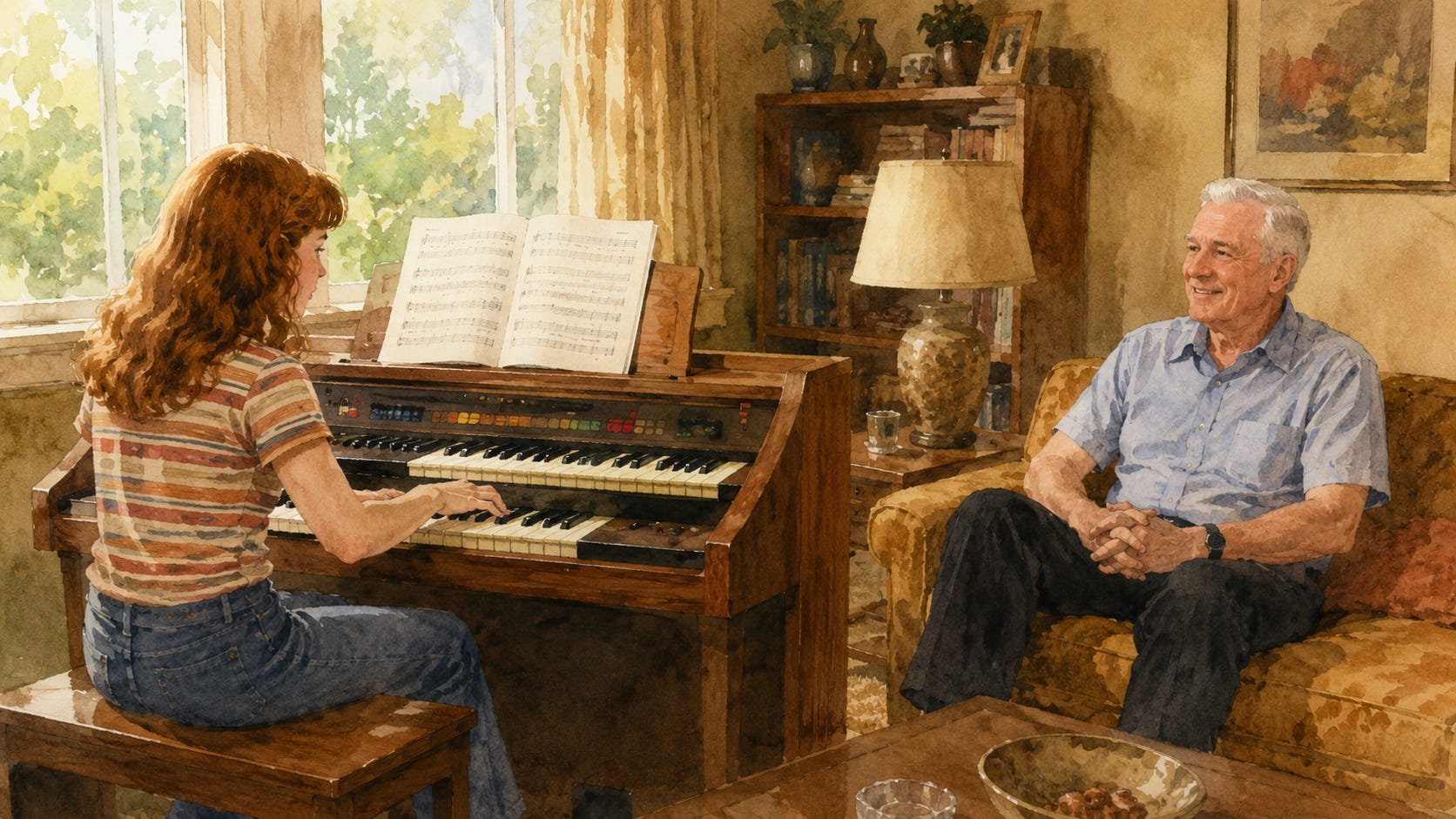
Every Sunday, you and Grandma made the trek to our house for dinner. The two of you wanted to spend time with us as a family. But you also came for your weekly organ recital.
When I was small, you discovered I could play keyboard instruments by ear. When I turned 12, you bought me a Lowrey organ. It came with EZ Play music books and a little folded paper cheater that I placed over the keyboard to show me which keys matched which notes on the music staff. I’d taken enough school music and band classes to understand basic notation. And so, every Sunday, I opened up those books and played classic tunes for you.
Every little breeze seems to whisper “Louise” …
Although no one sang the lyrics, you knew the tune, and you’d crow, “Maurice Chevalier! The Frenchman!”
I love you … for sentimental reasons …
“Ah,” you’d sigh. “Nat King Cole.”
The music flowed for you every Sunday. And I never once refused to play or rolled my eyes like the almost-teenager I was. I loved how much you loved what I could do.
But I couldn’t sing for you.
A few years later, when I as 15, you got me a job playing the organ at our family’s church. Eventually, I was asked to cantor. I resisted with every fiber of my being. But you knew I could sing, and so you nudged me, gently, toward this new way of sharing myself.
So, I sang. For the church. For the acquaintances and strangers in the audience.
But not for you.
I could sit down at the keys and play a song and sing when I was all alone, or even with a friend, but I couldn’t sing for you, the one person who would have appreciated it most. I’ve spent a lifetime trying to figure out why.
I suppose it was because you were so proud of me. You bragged about me. You told people I was a musician with talent and a beautiful voice. How could I possibly live up to that? How could I possibly be the talented, brilliant person you thought I was? Your praise drew attention toward me, but I wanted to fly under the radar. My childhood taught me that when people looked at me, they found things to criticize. The criticism hurt like a physical blow. I was terrified of the pressure to be perfect. So, if I just avoided doing things I loved — like playing music and singing — around people who might criticize me (or brag to people who would), I could avoid the pain.
I avoided the pain by hiding from who I am.
I did not sing at your funeral.
Our church held about 300 people. When you died, the sanctuary filled to capacity. People stood in the side and center aisles. People stood outside the door in the freezing January cold and snow to honor you. You were kind and affable. But you were also stoic and reserved. Although you mystified people, they loved you.
The little church choir sang, and I played the big Allen organ to accompany them. But this time, it wasn’t fear that stole my voice, it was sorrow. I had lost my person. The one who believed in me always. The one who celebrated my simple talents. The one who truly saw me.
I don’t know if there’s an afterlife, and I’m not afraid of the possibility that my consciousness will gutter like a snuffed lantern when I die. But I like to think that sometimes you see me.
Yesterday, the musical theater singers group I belong to performed with joy and passion for an appreciative audience who ping-ponged between laughter as Matt belted out gospel riffs in “Don’t Let Me Go” and tears when Ellie crooned “We Live on Borrowed Time.” My song was the penultimate number. Not a show-stopper. Not grand, but simple and honest. I sang “Feels Like Home” for a crowd you could never be in, but I sang it for you, and for every person I’ve ever loved who feels like home to me.
Every audience has its share of people who watch with flat expressions, unmoving and (possibly) unmoved. But when I glanced out this time, I saw people smiling, crying, swaying. Not because of my voice, but because the song itself transported them to their person, the one who felt like a light in the dark, the one who saw them just as they were and loved them that way.
You would have been smiling and crying, too, Gramps. And somehow, somewhere, I hope you did. Maybe, wherever you are, you hear my voice ring through on occasion and you pause to listen, smiling with pride.
“That’s my Boopsie.”