

For the happiest six years of my life, I was a white woman named Karen in love with a Black Vietnam Veteran named John.
We laughed at the same obscure references, knew all of the same obscure songs, loved adventuring together and discovering new places to eat where we could have a drink, share a plate of food, and then fight over who got the biggest “half” of our shared dessert.
We sang together. Always. All I’d have to do was kickstart John with a bar or two of any song, and we’d be off, harmonizing and grinning.
Also, we were both smart asses of the highest order.
I used my wit to laser-focus on people’s human foibles and gently tease them. Never in a hurtful way (I hope) but in a way that said, “Hey, I see you. We’re both flawed individuals here. Isn’t it great?”
John, on the other hand, used his powers of observation to quiz people, sometimes accidentally trodding on their tender spots. Not often, but whenever he felt especially mischievous, he’d push things a little further than strictly necessary. Like me, he wasn’t aiming to hurt anyone, either. Ultimately, his was a ploy to get people to loosen up a little. A ploy that rarely worked.
And sometimes John exploited someone’s tender spot and put me on the spot in the process.
Your subscription is creativity fuel! My stories are always free—no gatekeeping here—and just knowing you’re reading is motivating. If you’d like to kick it up a notch and support my work as a paid subscriber for $5 a month, I’ll thank you with a weekly writing prompt and access to my subscriber chat community.
Peace & love,
Karen
Juneteenth at Jimi Hendrix Park
Washington isn’t the whitest state in the U.S. (that’s Maine), but it’s not especially diverse, either. I’m a Washington transplant by way of Wisconsin, which is whiter still. So, the Juneteenth celebration at Jimi Hendrix Park was one of the few times in my life I’d found myself in the distinct minority.
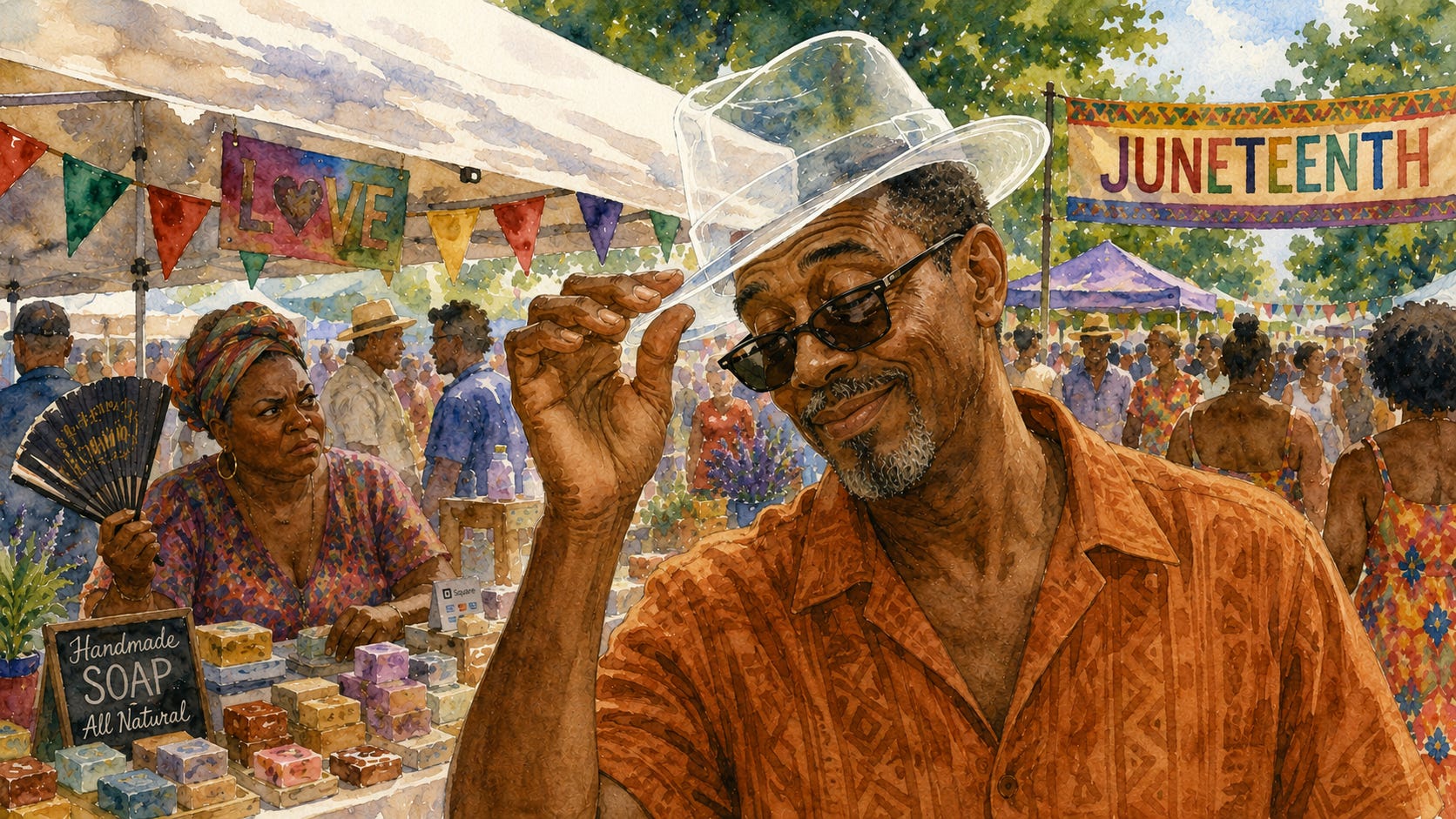
The event had music, food, and booths run by artisans selling handcrafted goods. (It was also hotter than Hades. Why does Jimi Hendrix Park have no trees or shade, Seattle? Do better.) John and I were strolling from booth to booth, checking out carved wooden masks, paintings, t-shirts, and African-inspired clothing.
We came upon a woman selling soap. The heat found her fanning herself with a flyer folded like an accordion, scowling out at the people browsing surrounding booths. As we approached, she looked me up and down with disdain.
John noticed. Because John noticed everything.
“How are you today?” he crowed cheerfully.
“Hot,” the vendor answered. “Yourself?”
Himself was comfortable, but perhaps a tad warm.
“So, Juneteenth,” he mused. “Tell me: Do you consider it a happy celebration? Or is it more of a somber one?” John loved thought-provoking conversation starters, but I sensed he was looking for an angle.
The vendor sneered. “What’re you talking about?”
“Well, those people in Texas back then,” John said. “Slavery’d already been abolished, but they were still slaves.”
“Well, they were freed either way” the vendor said, cocking one eyebrow at him. “You’ve got some strange ways of thinking.”
Oh, no. She was misreading John. She was getting him all wrong.
John had a habit of continuing conversations out loud that he’d started in his head, leaving them utterly devoid of context. Since I was his person, and he mine, I’d sort of made myself his de facto interpreter when others didn’t have a clue as to what he was referencing. John didn’t need me to interpret for him, and he never asked me to, but he didn’t judge me for it, either. I’m otherwise a bit shy with new people, but John knew my interjections were meant to keep the conversation flowing.
“He’s saying those people stayed enslaved for a couple of years after slavery officially ended,” I explained. “They needed troops to show up and enforce their freedom. So, I guess that could feel solemn instead of happy?”
Looking back, I see my mistake. Even though I ended with a non-confrontational, submissive little question mark.
The vendor didn’t know I had a habit of tying up the loose ends John left dangling. All she saw was some Karen (actually named Karen —the irony!) stepping in to explain what a Black man meant.
She glared at me, looking me up and down, and then narrowed her eyes at John and grumbled, “This your wife?”
The window of opportunity was open. John didn’t miss a beat.
“Nope,” he said. “My girlfriend.”
He gave the vendor a moment to mutter a disapproving, eye-rolling “Huh.” Then he delivered the second half of his one-two punch with a sly grin:
“Wife’s at home.”
If the vendor had been simmering before, now she’d completely boiled over. She launched herself up out of her lawn chair and leaned across the table, bellowing into John’s face: “You gonna buy something or what?”
John smiled beatifically, tipped an imaginary hat, and said, “We were just leaving.”
There’s no moral to this story. It’s an anecdote I share because … well, just because, I guess. Because it’s funny. Because it’s mortifying. Because fucking up is human, and some days I’m more human than I’d like to be. Because life is short and ridiculous and we take it far too seriously sometimes.
And also because, when John died in 2022, he left me with all of these stories, and the stories preserve who he was: A bard, a mischief maker, a healer, and an agitator (within reason).
He wasn’t above making a hot day ten degrees hotter.
I love stories about John. I first met in at Yoga class in the downtown ymca. Even then his spirit shone through all his conversations.
Awww. Love the "wife's at home" comment!