


I’m a Gen X OG — I was born on the Boomer/Gen X cusp.
But trust me, I identify fully with the generation that drank from the hose. Suggest otherwise and I will throw hands. Just sayin’.
I can quote “The Princess Bride,” “Ferris Bueller’s Day Off,” and “So I Married An Axe Murderer” verbatim. (I also drop little Gen X pop culture easter eggs into my posts randomly. If you find one, comment to shout it out. And also, you’re welcome.)
When it comes to love, my parents’ generation offered the first standard for me to follow.
It looked something like this:
A woman needs a man.
Your role is to find a man and get him to marry you.
You can’t get married and have kids if you don’t make yourself available to men.
Seriously, why aren’t you dating anyone? Is something wrong with you?
It wasn’t malicious, that standard. It was a remnant of a time when women had fewer rights and quite literally needed men if they hoped to thrive both socially and financially.
When I was born, women in the U.S. had only recently been given the ability to open their own bank accounts. It wasn’t until 1974 that the government banned banks from discriminating against women who wanted to apply for credit on their own. Before that, most banks required a woman’s husband to sign off.
I grew up in a state with marital property laws. When I was young and newly married, I couldn’t finance something like a car without my husband’s consent because we were considered to be entering into a debt and purchasing property together. (The same rules applied to husbands, but that never stopped me from having a problem with it.)
The message was this: You’re a single married unit now. As an individual, you no longer have agency.
So, when I was 27 and a man asked me to marry him, I did.
It felt like the expected thing to get married. Even though I knew in my gut that the man I’d chosen (or rather, the one who seemed to have chosen me) was severely damaged and probably mentally ill.
I got married because I was supposed to. Because it was a thing you did.
Other women — rebels who refused to bow under the expectations of generations of women who themselves were victims of the patriarchy — started going their own way in the 80s and 90s.
But I stuck the landing my family expected me to stick. And then I lived in a dysfunctional hellscape before finally breaking free once my kids graduated from high school. At age 49, I left my husband and my home state and headed to the Pacific Northwest, where I found love, happiness, and a community waiting with open arms.
But getting there, you guys … that was no easy feat.
My theory is this: No one’s ready for real love in their youth.
Okay, almost no one.
My son has friends who met in high school and are still together as happily married homeowners at age 30. And I think anyone in their friend circle would be not only shocked but devastated if their relationship dissolved.
So yes, young love works sometimes. But it’s rare.
One of the most read and commented-on stories I ever wrote (read it here on Medium without a subscription) told the story of how I found the love of my life at age 50 and came to understand what real love was supposed to be.
The most highlighted passage in that story is my simple declaration of what I believe love is:
Love isn’t about the pursuit of some fantasy ideal.
Love is safety and belonging.
Love is mutual respect.
Love is openness and acceptance.
Love is grace and forgiveness.
Love is when someone sees you just as you are — really sees you — and meets you where you’re at.
Love is not longing to change somebody; it’s letting your relationship with them change you.
— Karen Lunde (I Met My First Love When I Was 50)
My later-in-life love story resonated with people.
Readers flooded my comment section with their own stories of finding love, often after enduring something that was supposed to be love but … wasn’t.
Here’s a sampling:
“My husband was 50 when we found each other. We loved for 42 years before his death. Our bond is so strong it still comforts me 3 years 8 months and 7 days since his death.”
“What a beautiful story. I also found real love late in life (age 60) after leaving an abusive marriage.”
“I met my beautiful wife when I was 48 and got married three years later. We are so different from the outside but have very similar values. People are [in] awe [of] how we could stay together. Very simple, true love.”
”I was 49. He was worth the wait.”
It’s not that we can’t love when we’re younger — most of us just lack a roadmap.
I’m not saying people in their twenties and thirties are incapable of real love. Let’s get that straight.
But evolutionary psychology suggests that we’re biologically wired to seek a mate for the purpose of procreation during our fertile years. We might even subconsciously choose partners who appear fertile and capable of raising children.
Whether we like it or not, millions of years of “that’s how we humans do things” have played a role in our dating lives.
The relationships we have in our twenties and thirties feel very real. Because they are.
I refuse to discount any of the love I desperately tried to give and receive (and receive and give, because now I’m Joey preparing to officiate Monica and Chandler’s wedding on “Friends") when I was younger. It was a rough road much of the time, but it led me to a place where I could finally understand what love was supposed to be.
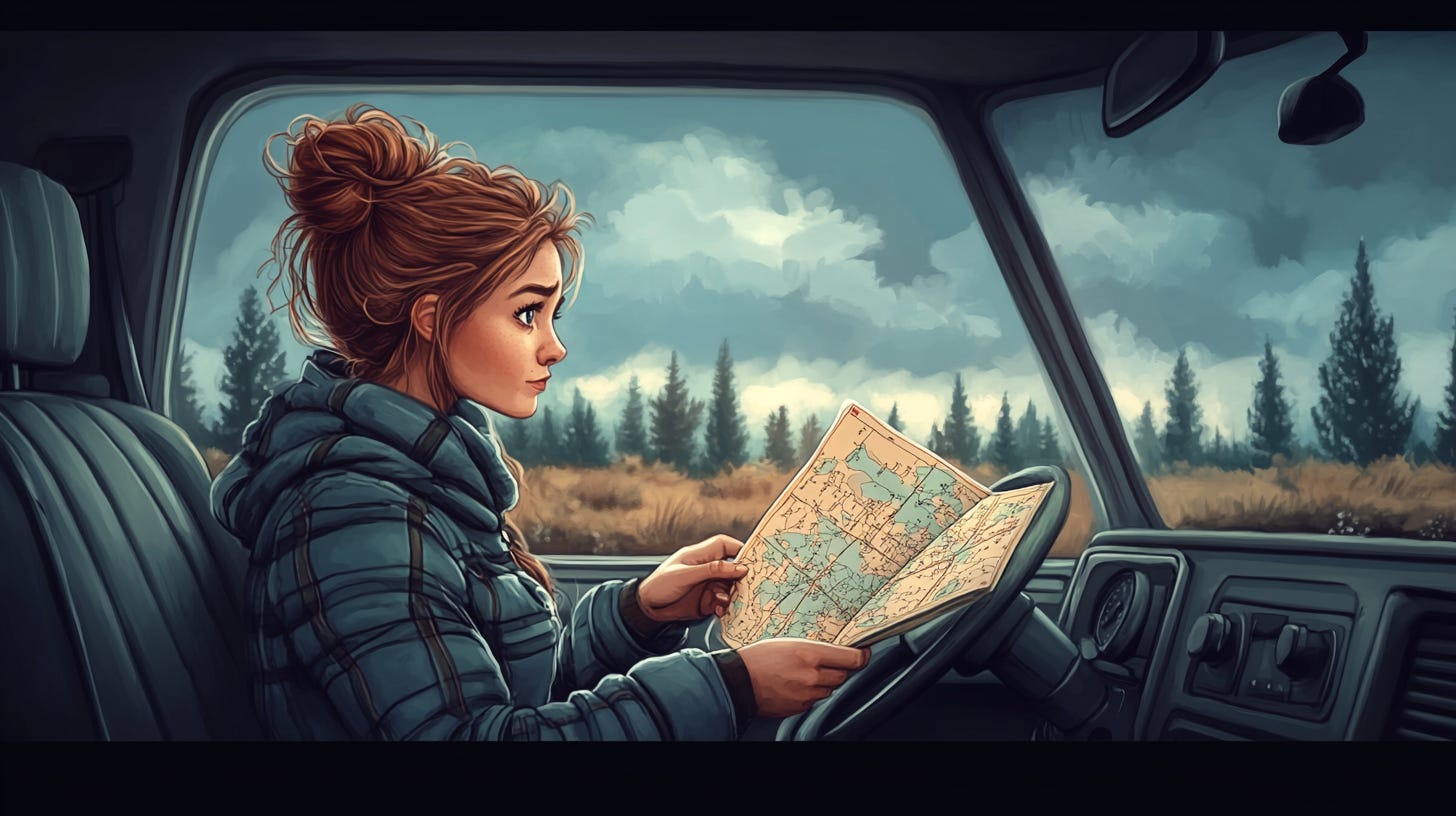
So, here’s the thing: There’s no Love GPS.
You can’t navigate your way to lasting love.
Instead, you have to navigate through love to get the map you need to find a relationship you’ll thrive in. (Unless you don’t learn from your wrong turns. Then you’re on your own, buddy.)
During your younger years, you’re like someone with the enviable job of driving one of those Google cars around mapping streets.
You don’t have a map yet because you’re literally making the map.
And that’s an important role, too. Map-making is an art. (Shout-out to my cartographer friend, Elizabeth. I see you, girl.) But map-making is the means to get you to a destination; it isn’t the destination itself.
And to me, that’s comforting.
I can forgive myself for the wrong turns I made when I was younger, because I was following an ancient, hardwired protocol. I can allow myself some grace instead of chastising myself for my “stupid” decisions. I can celebrate the things I learned that led me to the most profound and deep love of my life. I can recognize it for the gift that it was.
Perhaps you’ve reached that Lasting Love destination.
Or maybe you’re still making the map.
Either way, you’re on an adventure.