
Once Upon a Hill in Tacoma
A film, a parked car, and the arithmetic of us

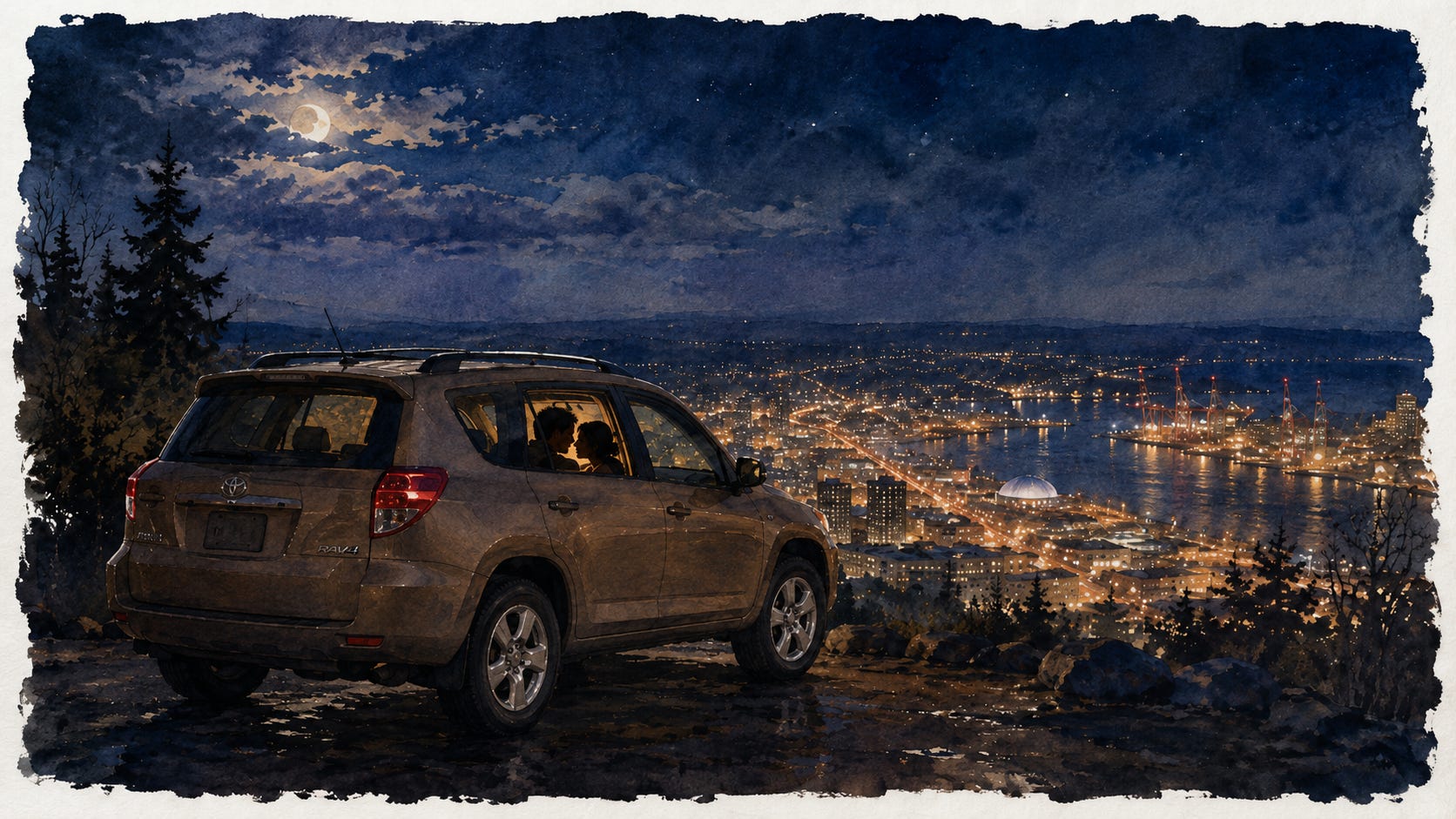
John and I have just left the Spiritual Living Center in downtown Tacoma, a quaint, musty Craftsman building that hosts Film Club’s monthly meetings. In the dim sanctuary, we’d settled into old wooden pews to watch Harold and Maude with a delightful group of film buffs, then gathered for a rousing discussion.
Now John and I will debrief as we head out in his RAV4. It’s what we do. We talk about the film, and we talk lovingly about the Film Club members.
We don’t talk shit. Everything comes from a place of curiosity and genuine affection. These are our people, even though a few of them know more about cinema than curious newbies like us ever will.
“Sandy was rocking the fuchsia hair tonight!” I say.
John utters his signature chuckle, a soft “heh heh heh” that conveys genuine amusement. “It’s a good one on her,” he says. “Better than that blue-green.”
“Teal, my love,” I say with a wink in my voice. “Precision matters.”
“I stand corrected! Fuchsia is better than teal. And maybe a better choice for someone pushing 90.”
I laugh. “Ageism! Let’s not gatekeep teal.”
He gives a sage nod. “Yes, indeed. I stand corrected.”
John reaches for my hand. He’s driving, and although it makes me uneasy when he has just one hand on the wheel in the city—less because I’m naturally nervous and more because John’s driving is suspect—I crave his warm steadiness. There’s a transfer happening here: his calm, easygoing energy traded for my ADHD-fueled excitement.
We’re new at this—less than a year into a relationship that will transform both our lives. And that newness fills the cabin of John’s car as we talk.
“The thing about that movie,” John says, “is how it just works.”
I nod. In the movie, a twentysomething man and a woman in her late seventies find one another and forge an intimate, even sexual, bond. And it never gets weird. In fact, it’s whimsical, subversive, tender.
“I’m not sure why it works, though,” John continues. His world is full of questions. It’s one of our strongest connectors—we are both endlessly fascinated by the world, by living.
I give John’s hand a squeeze. We’re both quiet for a moment. Then John purses his lips.
“That boy,” he says. “The funerals, the whole suicide thing…”
Yes. Harold is obsessed with death. He’s a rich kid who attends strangers’ funerals and drives a hearse. He stages fake suicides—hanging, immolation, you name it—for his socialite mother, who responds with weary, eye-rolling indifference.
“It’s like, ‘I’m Harold! Death is my hobby,’” I say. “But Maude—”
John chuckles again. “What a woman!” he declares.
At almost 80, Maude is a quirky force of nature—an impulsive, chaotic anarchist who steals cars, although she considers it “borrowing,” and crashes funerals for fun. She poses nude for sculptors and even frees a tree from a sidewalk so it can go live happily in a forest.
“It’s pretty trite, but… she really does live every day like it’s her last,” I say.
“You never know when it might be,” John says.
I feel myself flinch—not outwardly, but internally. There are things I don’t say. Can’t say. When Ra, my daughter, described John as “elderly,” I’d felt the same flinch and reacted with indignation.
“He’s not elderly,” I’d insisted. “Sixty-eight isn’t old! Your great-grandma was 94 when she died.”
But I wasn’t stupid. I could do the math.
John was vital, full of life, a seeker who roamed the world, staying impossibly busy with yoga, tai chi, mornings at the Plum Street YMCA, evenings at a favorite restaurant. He knew everyone, and everyone loved him.
But before we connected, I saw a man surrounded by people who seemed utterly alone.
“I think Harold had given up on living,” I say. “Until Maude came along.”
“I do believe you’re right,” John says, with put-on formality.
I thought of something John had said not long ago. He’d fixed me with a deep, concentrated gaze, all of his energy focused on my eyes as he said, with gravity, “You saved my life.”
I was stunned. I asked him how. How had I saved him? He had survived childhood trauma, Vietnam, the invasion of Panama, PTSD. He did not seem like a man who needed saving.
“Some things,” John had said, “are mine to hold.”
We’ve left downtown Tacoma now, and we’re climbing a hill through a residential neighborhood. Below, I see I-5 shimmering with headlights, taillights, brake lights—a moving mechanical sea. In the darkness, Puget Sound itself has become invisible, but the lights on the Tacoma Harbor cranes blink steadily, a reminder that industry is merely sleeping.
John releases my hand to shake out his own, then rests it on my leg. Its presence feels natural, as though he has always belonged with me, and yet somehow we’d been separated until just this year, when we met, fell in love, and John looked at me with wonder and said, “I’ve known you all my life!”
How strange to feel that you’ve known someone forever.
From the moment we met, we knew just how to be with one another. It was as though we had somehow existed for each other long before we met, and the eighteen years and thousands of miles separating us were nothing more than a cosmic clerical error.
Always.
I could overlook the arithmetic because it had nothing to do with us.
Right?
John had told me a story about his uncle Jeremiah, who’d solemnly informed him of a conversation he’d had with God about his lifespan: “I have requested 110.”
I told John he would have to live to 111, just to beat his uncle’s record. We laughed because it was funny, but I believed it because I needed to.
I look around, trying to determine where John is taking us. His navigation isn’t exactly aimless, but I can tell he has no real clue where he is. I also know he’s a man on a mission.
He’s looking for a place to park.
John responds aloud to my thought. “I want a spot overlooking the city so we have a view while I maul on you.”
I grin at the playfulness in his voice. To be “mauled” by John is to be loved intuitively, intimately, physically, breathlessly. It’s a ridiculous, beautiful word for a ridiculous, beautiful connection.
And so we’re a couple of teenagers looking for a place to park where the cops aren’t likely to cite us for indecency.
We’ve tried the parking lot next to Duke’s Seafood, right on the Sound. The idea of being caught thrilled us, but when our temporarily teenage brains slipped back into adult reality, we remembered that being caught had consequences.
What would Maude do?
She would laugh, dance, play music, sing, steal a car or two. She would crash a funeral to remind herself that life is fleeting and meant to be lived fully, robustly, honestly. She would say that life begins when you stop worrying about how you’re perceived and start being you.
And that safe feeling that shows up quietly, almost secretly, when you no longer have to put on a face is not just love. It’s life. It’s a paradox—both peaceful and challenging. Because even when you’re free to be exactly who you are, you still can’t voice the things you hide from yourself.
John puts the RAV4 in park. The city glimmers below us. He turns to me, takes my face in his hands, and kisses me. When the sensations are just right, we murmur to one another:
“Mm-hmm…”
Yes. Yes, this.
This feeling is life.
And I know, even then, in the smallest, most obscure corner of my mind, that one of us will someday have to live without the other.
I know it the way I know the Sound below us is dark and vast and leads to places no one has ever gone. I know it the way Maude knows she will bring her life to a conclusion on her own terms by taking an overdose of sleeping pills on her eightieth birthday.
In the final scene of Harold and Maude, Harold drives his hearse off a cliff. But he walks away, his obsession with death sailing over the cliff with the hearse.
Tonight, John is warm beneath my hands. And when we’ve finished, he turns to me. His eyes meet mine in the dimness and lock on, their corners crinkled, emanating warmth and profound love.
“Hi,” he says.
Has someone ever pulled you back into your own life just by loving you? I'd love to hear about it in the comments.