


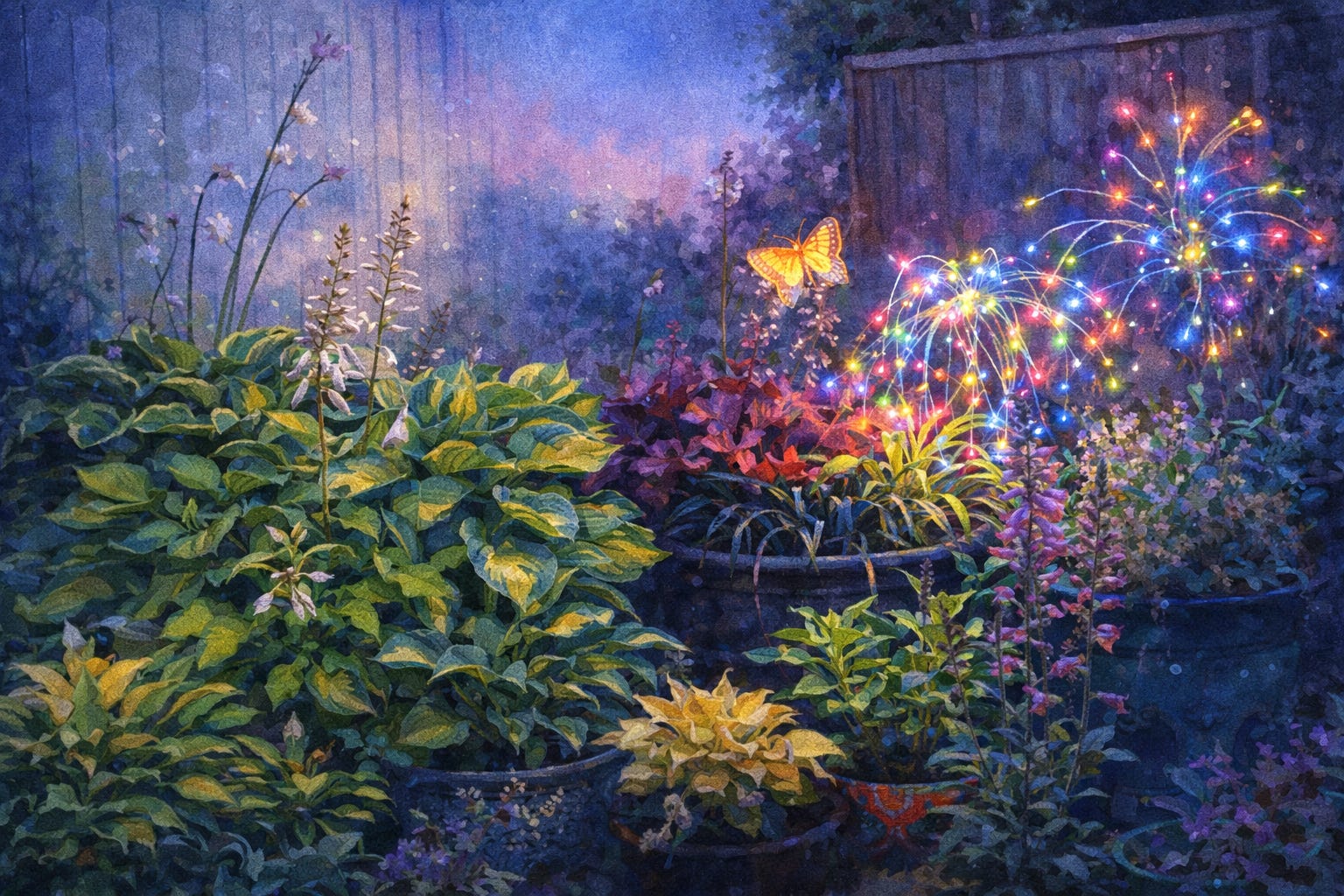
Every spring, I can’t wait to visit the local garden centers. My daughter and I go almost every weekend to wander among the plants, smell the earthy scent of fresh soil, and dream about what we’d do if we had unlimited disposable income.
Only I’m more than just into visiting garden centers to look at all the pretty stuff; I tend to come home with plant babies and absolutely zero idea about where they’re going in my yard. I’m more interested in the fun part — shopping for plants. Digging and planting? That sounds like work. I simply want to enjoy the fruits of my shopping labor without any additional labor. Which is a problem. Because it turns out that, when neither planted nor lovingly tended in a nursery environment, plants don’t thrive.
Often, they die. And then I have sad little plant funerals as I dump the plant matter into a wheelbarrow, headed for the compost pile. Sometimes, I reflect on the money I wasted on what inevitably became a dead plant.
But why? What perpetuates this tragic cycle of plant neglect?
Perfectionism.
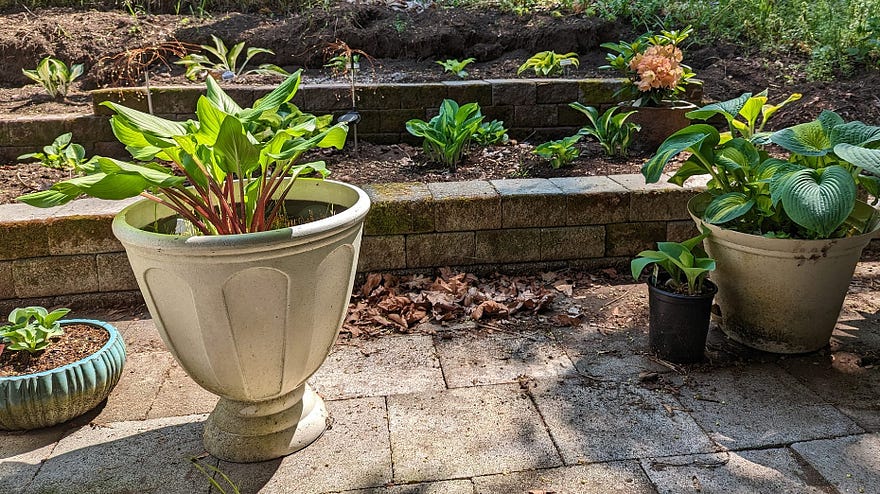
This is what perfectionism looks like
I stepped back to look at Operation Plant Neglect and I think I’ve realized where I’m going wrong. Here’s what my thought process looks like each time I come home from the garden center with an armful of healthy but fearful new plant children.
Unload plants. The plants must be lovingly unloaded and placed somewhere near a hose, so I won’t forget to water them.
Wander around the garden. Now it’s time to contemplate where the plants must go. I have a lot of space, but much of it is still unprepared for planting.
Realize there are no good spots because the garden isn’t what it’s supposed to be yet. That bed over there is supposed to be bigger, and less rectangular so it looks more organic. And that other bed needs weeding before anything gets planted.
Get dispirited. This is where the perfectionism kicks my ass. Because as I wander around my garden, I realize that it’s a million miles away from being anything like I actually want it to be. Which is to say, it doesn’t look like the nearest botanical garden.
Neglect plants. Because I’m dispirited, I’m less into the idea of working on my horrible, flawed, no-good garden. So, you know, I’m just going to forget to water those new plant babies until they’re so dehydrated they’re crying dust.
Mourn dead plants. Yep, they’re dead alright. And so now it’s time to mourn both those beautiful plants and the money I spent on them. (Which can be significant, right gardeners? If you know, you know. Fortunately—for the plants if not for me—I’m so broke right now that I’m not bringing home many plants to murder this season.)
Swear I’m the worst, meanest gardener ever. I’ll tell everybody how much I suck at it. Because clearly when they look at my yard, they’re already aware that I’m a lazyass plant murderess.
Embracing the imperfect
Before I lived (and wantonly killed plants) in the Pacific Northwest, I had a sweet brick Victorian house in a small town in the Upper Midwest. It was the shadiest yard ever. (As in “shaded by trees,” not as in “sketchy.” Although I see why you went there.)
So I got into hostas. Because that’s what you do when your yard is shady.
Back then, I had my son help me dig and haul bags of dirt and compost. He did the easy manual labor while I did the difficult, labor-of-love part: I kicked back and read everything I could about growing hostas. (Listen, the kid doesn’t have sciatica, I do, okay?)
I spent the better part of six summers expanding my hosta garden. (Yes, even after my son abandoned me to get a college education. The nerve.) And it was always a mess. I’d get the weeds cleared out of one patch, and then the dandelions and thistles would show up, or the unruly scrub trees and privet hedges would grow faster than the list of criminal charges against Donald Trump. (Yes, that fast!)
My garden was ugly, ugly, ugly. It looked like this. Clearly awful.
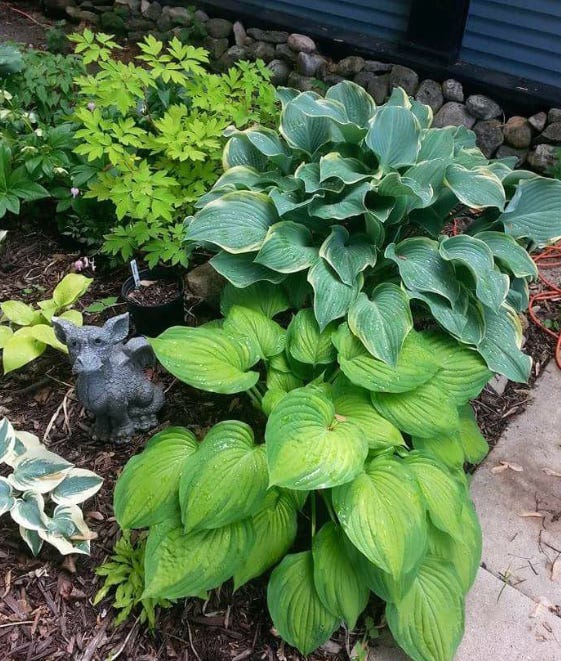
I wanted my garden to be perfect. When I looked at it, all I could see were the weeds, the overgrown hedges and scrub trees, the fence in need of paint, and the hose I forgot to roll up and put away.
Then, one day, I got a moment of clarity thanks to a neighbor walking her dachshund.
I lived in a quiet old neighborhood filled with simple country Victorian houses and Craftsman bungalows. Many people had pleasant yards and a few had pretty gardens. I always compared my garden unfavorably to everyone else’s, certain that I’d been labeled the slacker on the block they all got together and secretly complained about.
But the dachshund lady felt differently.
I was kneeling in my front garden pulling weeds. (And probably swearing under my breath, but let’s not diminish this moment, shall we?) The dachshund lady stopped, looked down at my garden, and smiled sweetly. She greeted me and we shared some small talk about the nice weather.
Then she said something that stumped me.
“I’m constantly amazed by your beautiful garden,” she said. “Every year I say to myself, ‘Look what she’s done!’”
Obviously, she was just being nice, so I responded with a shrug and a self-deprecating, “Well, it’s a work in progress. The weeds are winning. And that privet hedge …”
She looked around. Her dachshund did, too.
“I don’t see what you see,” she said, clearly puzzled. She gestured at the landscape, sweeping her hand out in front of her like Vanna White displaying the prize showcase for a winning Wheel of Fortune contestant. (Back when they did the prize-shopping thing, that is. I’m old.)
“It’s just… I have a lot of work to do on it,” I said to dachshund lady. “It’s not quite ready for prime time.”
“You’re a perfectionist,” she observed.
“Maybe?”
“Well, don’t let the quest for perfection stop you from seeing the beauty in the imperfect,” she advised. Which was the wisest thing to say, but at the time, it sailed straight over my head.
“But I don’t want it to be imperfect,” I whined.
She waved her hand again, as though shooing away a fly. “Nonsense!” she said. “Everything’s imperfect.”
Although I dismissed it at the time, I’ve remembered what dachshund lady said ever since, because it was one of those lessons I didn’t know I needed.
Everything’s imperfect. And that’s the beauty in it.
Take a bite out of this little anecdote — it tastes just like mixed metaphors:
When I was about 20, I worked in a music store where I sold pianos and organs. Every so often, a blind man named Harry came in to tune the pianos. I adored him. He was sweet, funny, and a talented pianist. After he’d finished tuning some Kimball spinet, he’d test it out by playing a little ragtime or blues.
As old people often do, Harry died. One of the piano teachers, a woman with perfect pitch, replaced him as tuner. As she was tuning one day, I heard her sniffling and noticed she was crying. So, of course, I asked whether I could help.
She told me she missed Harry, and she just couldn’t tune a piano like him, and it made her sad.
I asked how it could possibly be true that she couldn’t tune a piano as well as Harry. After all, she had perfect pitch.
“That’s the problem!” she said. “Harry always tuned everything just a tiny bit off on purpose.”
I asked why he would do such a thing, and she grabbed a guitar off a nearby rack to demonstrate. She placed her fingers on the fretboard as if she was tuning, something I’d learned to do as a Music Center employee. She plucked two notes that should have sounded the same, but the guitar was out of tune, so they sounded horrible played together.
“Listen for the soundwaves,” she said as she cranked a tuning peg. “Hear how they get wider the closer the guitar gets to being in tune?”
I nodded. Yes, I was accustomed to this. I would tune the guitars until I couldn’t hear those waves anymore. When the strings were perfectly in tune, you couldn’t hear the whaaahm … whaaahm … whaaahm of separate soundwaves bouncing off one another. (Or whatever it is soundwaves do.)
“You want just a little wave — the widest sort of vibrato — to give the sound warmth and character,” the piano teacher/tuner said. “But I can’t seem to do that. All my ear will let me do is make it pitch perfect.”
So, there you have it. The imperfect is actually perfect.
Because the imperfect mirrors life. And life is messy, chaotic, and complicated. But that’s what gives it warmth and character.
That’s what makes it beautiful.
I’m still trying to embrace this truth, but I’m making progress. I might even let my ukulele be just the tiniest bit out of tune.
I will try to be less concerned about how my garden looks. I won’t wait for it to be perfect before I put a plant in the ground — I’ll plant them wherever I want and move them if I decide I don’t like where they landed.
I will plant around the weeds, and before the beds are perfectly naturalized. I’ll let the wildflowers grow where they want to, and leave the dandelions for the pollinators.
And I will, slowly, learn to be okay with that.
Thanks for reading! If you’ve enjoyed my work, you can support this crazy creative pursuit of mine by becoming a paid subscriber for $5 a month. (Drop a fiver, feed an artist! It’s a whole thing!) I’ll send you a writing prompt every week and invite you to my new chat community as a thank-you.
Already a subscriber? Scroll down for this week’s prompt!
