

I’m at choir rehearsal, but not really.
I signed up for this treble choir because the director of another choir I belong to wanted an opportunity to sing and dragged me along for the ride. But I’m not really vibing with the music selection and I don’t know anyone here. I’ve also just bought my first house, so I’m in the middle of a stressful move … and it’s my birthday.
For the first time in our five years together, John seems to have forgotten my birthday.
And I know that’s partly because I haven’t casually reminded him. If I’m completely honest with myself, it was a kind of experiment to see whether my beloved would remember or if the C-PTSD caused by years of military service (starting with the Vietnam War) would secret the date away from his memory.
It’s not a mean experiment, just a curious one. Because I’m not (very) attached to the outcome. I mean, of course I hope he’ll remember. But I’m also a realist.
When the rehearsal ends, I trudge to my car, ready to just go home, or at least to the box-riddled disaster that’s still home for the next week before the movers come. I always leave my phone in the car during rehearsals so I’m not distracted. As I climb into the car I pluck it from the center console storage and, like the trained monkey that I am, check my notifications.
Seven missed calls, all from John. Only one voicemail message, “Hey, darlin’! Where you at? I’m trying to track you down for a birthday hug.”
Oh, John.
I look at my texts. And again, they’re all from him. All of my other birthday greetings have come in much earlier.
JOHN, 7:11 pm
Where ya at, sugar?
JOHN, 7:36 pm
Driving over to your house
JOHN, 8:07 pm
Gonna check your new house
JOHN, 8:32 pm
Back to your old place!
The rental house I’m leaving and the new one I’ve just closed on are about 25 minutes apart. I imagine John spending over an hour driving back and forth, frantically searching for me, and my heart clenches.
Maybe my experiment was mean after all.
I try to call him, but get no answer, which isn’t unusual. John’s an enigma, especially when it comes to phone communication. So I send a text:
KAREN, 8:52 pm
I was at choir rehearsal, love
As I drive home, regret washes over me. Why did I do this to the man I adore with every piece of my soul? Why did I stubbornly refuse to give him a reminder just to “test” his love for me?
I imagine him suddenly realizing the date. He rarely curses because he says the Army exposed him to enough of it across his 23 years of service. So, I picture him settling into his favorite recliner for the evening, casually checking his Facebook feed, seeing a flood of birthday wishes coming my way, and muttering a frantic “Oh, shoot!” while bursting out of his chair and into action.
A weight settles into my chest and my eyes mist. I know John, and so I know in my bones that he’s mindful and easygoing, unlikely to feel plagued with guilt for missing a special date in the same way I would be. He also knows I won’t be angry, nor will I judge him. We’ve always accepted one another just as we are. It’s why our relationship is magic. And yet I also know, in that moment of realization, that he felt remorse. Enough of it that he raced from my rental, to my new house, and back again frantically trying to find me.
That realization is a punch to the chest—part regret, part empathy response, all love.
I think again about my box-riddled rental house and how difficult it is to navigate right now. And I realize that John’s own mental house is also full of boxes, all the compartments where he stored fragments of memory.
A Black man from the Jim Crow-era south, the boxes containing John’s childhood story were filled with events a child shouldn’t have had to experience and a man shouldn’t have to remember. The Vietnam War brought new, fresh horrors to lock away from the daylight. And John had also taken part in the 1989 Panama invasion. When he told me he’d been part of the operation “blasting rock n’ roll music at Noriega,” I had the luxury of thinking of it as a soundtrack. To me, it was a fascinating piece of history; to him, it was a perimeter.
I remembered being with John, driving up I-5 to Seattle, when we encountered a behemoth, snub-nosed plane on approach to land at Joint Base Lewis-McChord. Stunned by its massive wingspan, I asked what the hell that was, and he’d said, in his calm, authoritative tone, “C-130. Military transport for paratroopers and supplies. ‘Flying Hotel’.”
So when John told me that Panama had been beautiful, filled with “flowers and backyard chickens and mosquitoes the size of C-130s,” I had laughed. Neither of us (me from the surprisingly swampy Upper Midwest, him from the deep south) were unaccustomed to supersized mosquitoes, but this sounded next-level.
John gave a wry smile and said, “The place always felt dangerous. You couldn’t sleep. All you could do was watch your back.”
I understood then that it was about more than backyard chickens and huge mosquitoes. In Panama, being in the wrong place at the wrong time could prove fatal. And I realized now that maybe to John, not finding me where he expected me to be—me being in the “wrong” place—might feel like more than a missed opportunity for a birthday hug. And the brief, staccato phone messages while I was in rehearsal were mission critical transmissions from a man who’d learned long ago that silence meant safety. John had been running a tactical maneuver back and forth across town.
For me.
And maybe that’s what caused tears to rim my eyes. I was in love with a man who, as a paratrooper, jumped out of the first plane he’d ever flown in. And while I smiled when my Johnny Jumper approached a fellow vet with wings on his leather jacket and said, “Excuse me, but you look like a man who used to jump out of perfectly good airplanes,” I hadn’t fully taken in the weight of everything that shaped the man I loved.
And I hadn’t fully taken in just how much that man loved me.
John had spent 23 years in an Army that demanded he never leave a person behind. Now, in his civilian life, that hard-wiring had turned toward me. He wasn’t just a partner who forgot a date; he was a soldier who had lost his mark and was refusing to stop until he found me.
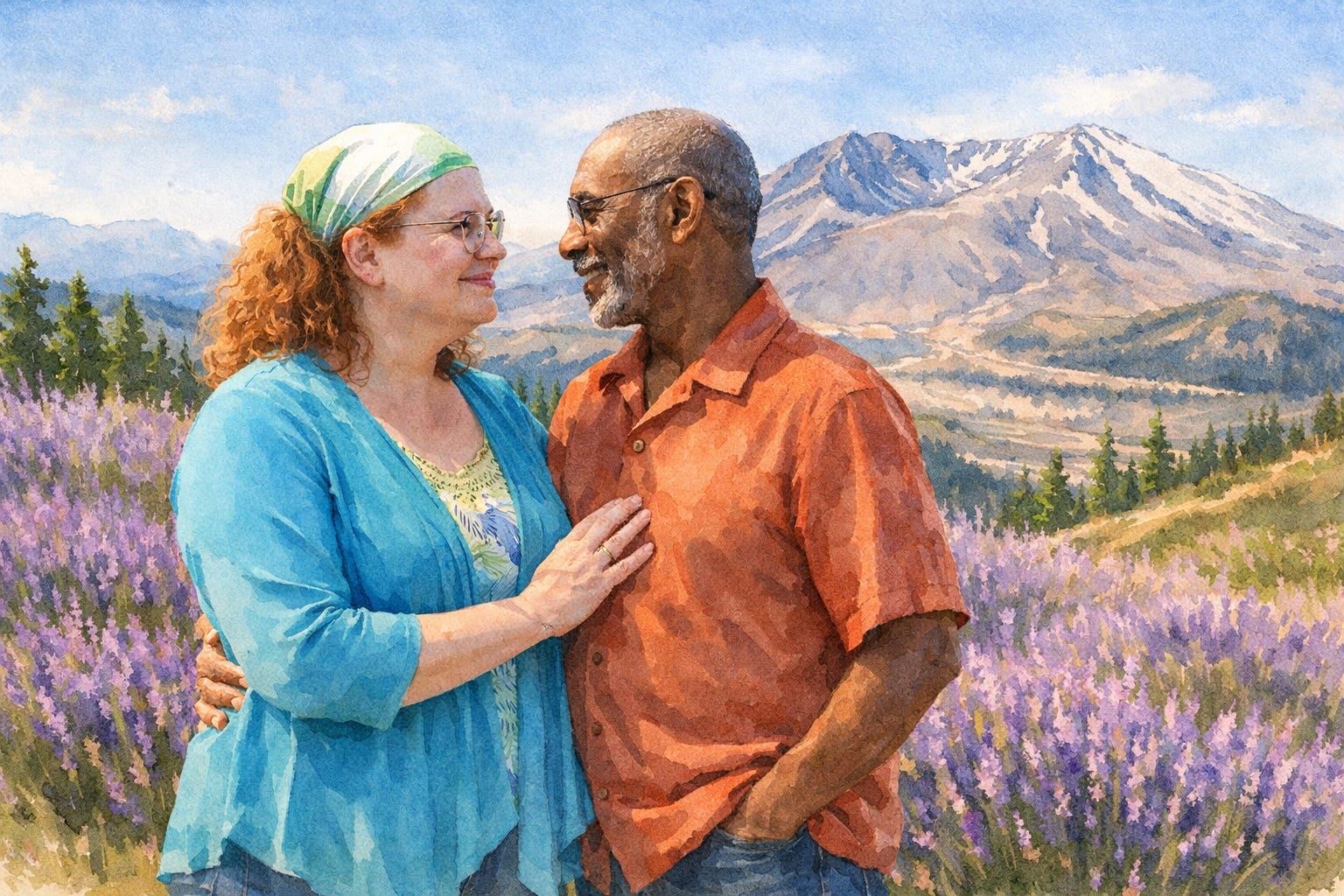
That weekend, we went to our favorite Italian place for dinner. Later that year, we went on a “mission” (John’s term) to visit the Mount Saint Helen Visitor Center, where we could still see the aftermath of another catastrophe, this one not of the human-caused variety. And that mission would be the last one I took with John.
In the weeks leading up to a scheduled (and relatively minor) surgery, I sensed a growing desperation in John. Although we never spoke about it, I suddenly felt like he was marking tasks off on a checklist:
Visit elderly uncles in North Carolina. Check!
Call military friends he’d fallen out of touch with. Check!
Take Karen to Mount Saint Helens. Check!
The night before his surgery, John came to my house before setting off for the military base, where he would stay in a hotel near the Army hospital. (Say goodbye to Karen before setting out for the hospital. Check!) He called from the hotel to say goodnight and “tuck me in.” He would call, he said. Probably in the afternoon after the anesthesia had worn off.
“Night night, sugar,” he said, his voice full of good cheer that I’d long since learned was a mask for anxiety. “I love you!”
I couldn’t be there when he coded in the recovery room, so I wasn’t there when his beautiful soul departed his body. All I had now was yet another text, but not from John:
John went into cardiac arrest in recovery and sadly passed away.
I couldn’t help but think that John would have hated leaving his mission to connect after the anesthesia wore off incomplete. He would have hated that his “leave no one behind” training had been subverted—he’d left me behind, bereft and hollowed out.
A few days after his death, I found myself freshly out of the shower, numb and dripping onto the bathroom rug. I couldn’t see a path forward. I had wrapped my life around John’s, made him the center of every adventure. I buried my face in my hands and sobbed, crying, “I want to be where you are!”
And it was then that I felt something wrapping around me, a presence. Sacred warmth. Electricity. I can only describe it as an “energy hug.” And it was unmistakably John. I have long believed that the things we call “supernatural” are just “science we don’t understand yet,” but I also know the first law of thermodynamics: energy cannot be created or destroyed, only transformed from one form to another.
John had come back to complete his mission.