

Every Sunday, my mom would add two leaves to her dining room table and welcome her extended family to dinner. As she prepared a meal in her tiny kitchen, which we weren’t permitted to enter while she cooked lest we earn the patented “Mom Look of Death,” we’d sit and chat. When the meal was ready, we’d gather and eat, continuing the conversation.
Most of the time, those conversations were about trivial stuff. And for me at least, that was by design. I was unlike every other member of my family. I wasn’t outdoorsy, I didn’t even drink socially, and I live more in my head than my body. I’ve always felt different. I’ve always known there was a reason my childhood self felt deeply connected to the story The Ugly Duckling.
My own partner provided some independent verification of that self-belief when he met my family for the first time.
"Well, now you know where I come from," I said to him as we headed for home.
"I can tell you’ve got history," he said, “But you’re nothing alike.”
So mostly, I stayed in my own lane at family gatherings. Better not to stand out. Better to be the quiet, easygoing duckling than the ugly one who gets mercilessly teased.
It was my dad who shot me down, after walking in late (as usual), reheating his dinner in the microwave (as usual), and eating alone at the dining room table (as usual). Maybe it was an election year. Maybe Something Big had just happened in the news. Normally, I avoided talking world news or politics with my family because I was the outlier—the progressive amidst conservatives. But on this Sunday, Dad had come home after his usual "few beers" in the sort of mood we all instinctively knew could be volatile. And politics came up.
Because of course they did.
My dad isn’t a bad person, just a complicated one. He’s intelligent, a patent holder, someone with big dreams and (almost certainly) ADHD who never fully managed to bring those dreams to fruition. But when he thinks he’s right, he digs in his heels. Pushing back was a sure way to end up in a squabble.
Nothing epic. Nothing frightening. But, at least for me, something that always stung.
So, the topic of the debate may be lost to memory, but my reaction is not. I refused to back down when Dad told me my thinking was flawed. I leveled a strong counterargument. I insisted on making my case.
“That’s crazy!” Dad raged, his voice going up half and octave.
I remember feeling cornered, like there was no way I could get out of this particular argument unscathed. But I pushed back anyhow. And although I led with logic, I’m sure by then I’d gotten emotional, too.
Whatever I said, Dad wasn’t having it. He stood up, waved his hand dismissively at me, and barked, "You’re ridiculous!"
And at that moment, I felt myself shrinking. Collapsing. Because my parent, a person who was supposed to represent safety, had called me “crazy” and “ridiculous.” I was on the verge of tears, and the very fact that I was about to cry pissed me off so much that I retreated to the bathroom, slamming the door behind me.
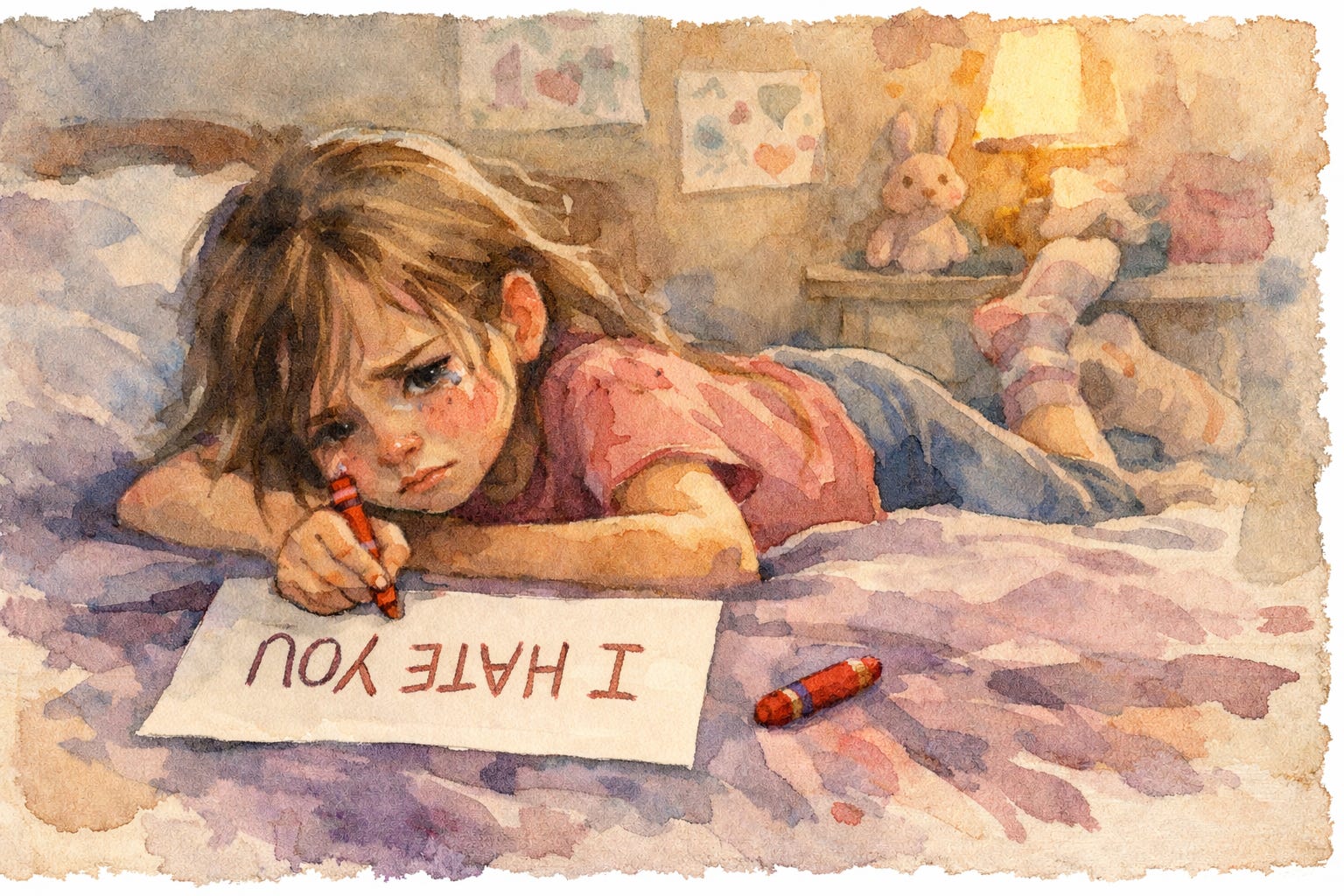
I have a vivid memory of being ten years old, vibrating with a brand of hurt I didn’t yet have the vocabulary to explain. I remember retreating to my room, grabbing a piece of paper, and scrawling “I HATE YOU!” in desperate childlike loops. I folded it into a paper airplane, a sort of vehicle for my mute rage, and launched it down the stairwell. I watched it glide down toward the living room, where the muffled sound of the TV signaled that life for my parents was continuing, undisturbed, while mine was falling apart.
Decades later, in that bathroom, the paper airplane was gone, replaced by a heavy wooden door I slammed with the full weight of my adulthood.
But the vibration was the same.
Here I was: a woman who had survived a crumbling marriage to an abusive man, a mother who was raising two teenagers in a world that felt increasingly volatile, a person who had fought for every inch of her own agency. Yet, in the face of my father’s “mad voice”—his incongruous, high-tenor bellow—I wasn’t a peer. I wasn’t a patent holder’s daughter.
I was just a target.
After breathing through my distress and calming myself down enough face the family gauntlet again, I opened the bathroom door, told my kids we were leaving, and headed out without a word. The last thing I heard before closing the door behind me was Mom saying, "Why do you have to be that way with her? What is wrong with you?”
As I drove home that evening, the echo of my mother’s voice—What is wrong with you?—stayed with me. She wasn’t asking me; she was asking him. But in the silence of the car, I realized I had spent a lifetime trying to answer that question for myself.
We often think of ‘home’ as a destination or a fixed point of safety. But for many of us, home is a shapeshifter. It is the place where we are most known, yet most misunderstood. It is where we go to be filled up, only to find ourselves shrinking to fit into the old, cramped boxes our families built for us decades ago.
This brings me to this week’s prompt. I want us to look at the ‘architecture’ of our own belonging—and the moments where the walls start closing in.
As a paid subscriber, you’ll receive a new writing prompt each week — small doorways into memory, meaning, and the beautifully messy architecture of being human.
You’ll also have access to our quiet, thoughtful chat space — a place to reflect, connect, and, if you’d like, share your writing with others walking a similar path.
Most of all, you have my sincere gratitude. Your support makes truthful, vulnerable storytelling possible.
