


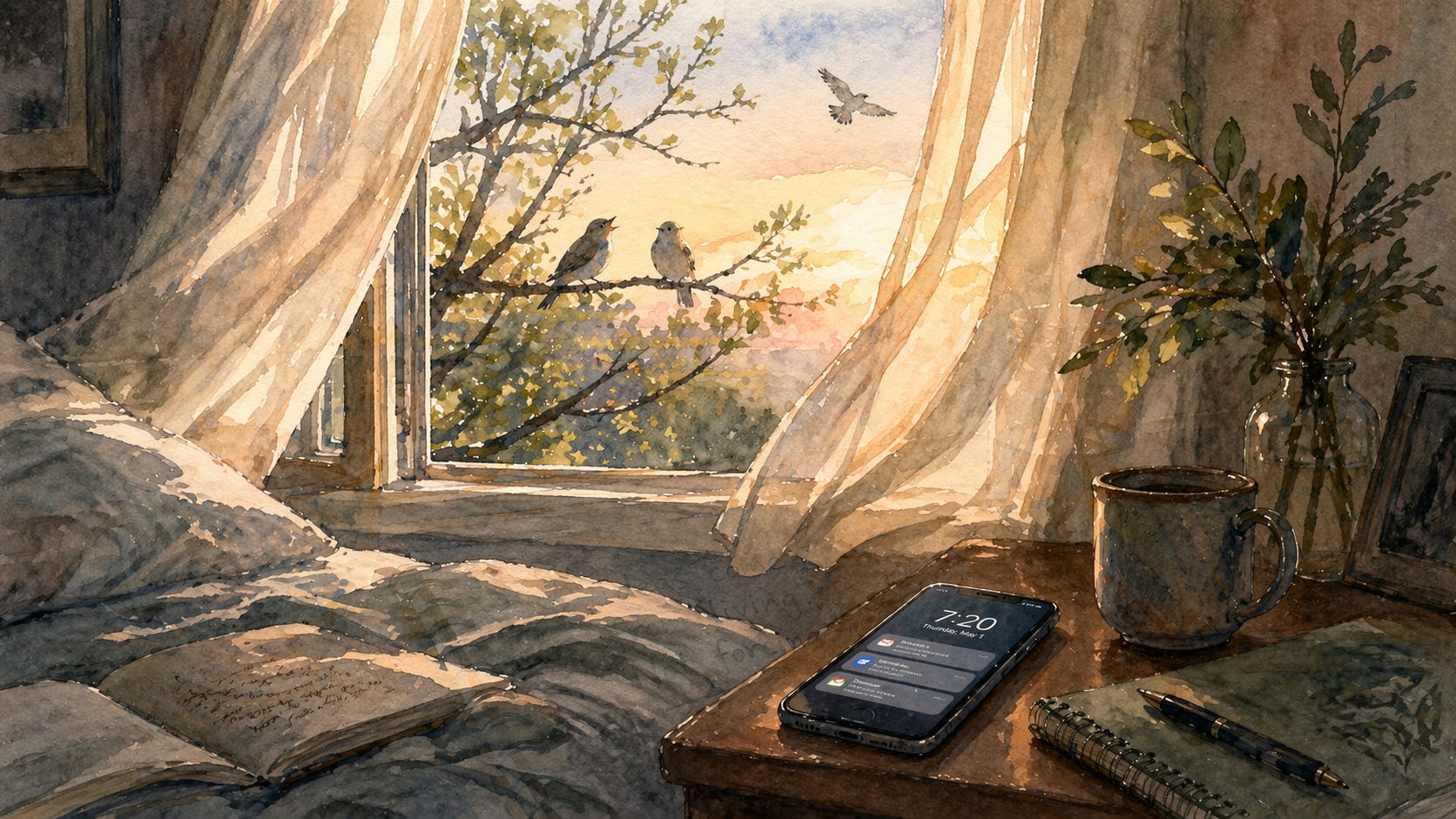
I wake at 7:20. Because I don’t have anything pressing to do, I opt to stay in bed for a while savoring the delicious early morning quiet. I share my home with my adult daughter, but they’re off to work. The dogs are quiet, probably resting after having had some morning exercise and breakfast.
Today, I won’t reach for my phone.
Seconds tick by. I tell myself how blissful this is, just lying still in the thin morning light with green noise playing on the Bluetooth speaker beside my bed. So peaceful. So soothing, so… unbelievably boring.
Maybe I’ll just check today’s weather.
I whisk the phone off its charger and soon I’m not only checking the weather, I’m reading email, scrolling Substack, replying to Notes, checking Facebook to see what my friends are talking about, hitting up my favorite news sources to make sure the world’s still properly on fire. That kind of stuff.
I rarely make it through more than 10 minutes of do-nothing without reaching for digital stimulation. In part, I can blame my ADHD—the little device in my hand is an instant dopamine delivery system.
But it’s cultural, too.
I work part-time as an office manager for a Quaker community, and my one in-office day is Tuesday. I also rehearse with my musical theater group on Tuesday nights, so rather than drive 30 minutes home only to come back into town 30 minutes later, I stay in town for dinner. I’m poor (I prefer the term “starving artist”), so I often just grab a sandwich. But occasionally I splurge on a sit-down meal. And every time I dine alone, without someone to talk to, I find myself staring at my phone.
Then I look up from my own device to see a handful of other people—even people in groups—bathed in the blue glow from a screen. I mean, I get phone scrolling if you’re alone; it can be a little awkward sitting in a restaurant by yourself. But when you’re with other people? Make it make sense.
* * * *
I find myself wondering about my childhood a lot lately. Maybe that sort of reflection is part of turning 60 and being closer to the end of my life’s timeline than the beginning. Or maybe it’s because I’m mourning something: a fracture.
The internet would’ve helped me in profound ways if it had been part of my childhood. When my parents offered “I dunno” shrugs to my many questions about life, going to college, exploring new things, I would have been able to meet those shrugs armed with the resources to do it myself, something I’ve always had a hard-earned talent for.
But I’m also grateful that I grew up without a phone in my hand or a laptop on my desk.
I’m grateful for my grandparent’s old typewriter, gifted to me when Grandma stopped being secretary of her bowling league and no longer had to type up minutes. With that typewriter, I started pecking out the stories only I could tell. And I became a writer.
I’m grateful for the hours I spent in the woods as a child, clutching a tiny camera that used 110 film and snapping close-up photos of leaves, sunbeams shining through the trees, and animal tracks. With that camera, I became a careful observer who notices, and celebrates, the tiniest of things.
I’m grateful for my grandma’s little ceramic lantern with the moss rose pattern, which came out just for special occasions. Somehow, that little lantern gave real meaning to important days. Walking into the bathroom and finding it lit there on the toilet tank, its delicate lamp oil smell wafting through the air, meant the day had significance.
But the days feel less significant now, for some reason.

I’m longing for a past that only feels perfect in retrospect. Maybe the state of the world today has me nostalgic for times that seem simpler but, in reality, were just complicated in different ways.
I do know this: I didn’t used to store my memories on Facebook.
Today, memories pop onto my Facebook feed like spring ephemerals—flowering plants that show up briefly and then fade away, leaving no trace until next season. I find myself wondering whether those memories would resurface for me at all if they didn’t live on my Facebook timeline. Maybe, instead of reappearing annually, they’d live in my body and mind. Many of them would show up randomly instead of on the exact day they happened X years ago. They’d appear because I witnessed something that reminded me of them, or joined a conversation where I could contribute that memory to the dialogue. I wouldn’t simply scroll past the good memories; I would embody them. They’d be part of my emotional life, not my digital one.
That’s what the politics of attention fractured. It broke our ability to participate in our own lives as humans by grouping us into performers and spectators, performing for algorithms like trained monkeys.
And it makes us reach for our phones at 7:20 a.m. instead of savoring the breeze coming through the window carried on a ribbon of birdsong.
Thanks for reading! If you’ve enjoyed my work, you can support this crazy creative pursuit of mine by becoming a paid subscriber for $5 a month. (Drop a fiver, feed an artist! It’s a whole thing!) I’ll send you a writing prompt every week and invite you to my new chat community as a thank-you.
Already a subscriber? Scroll down for this week’s prompt!
