

The text from my brother sends an electric jolt through my core.
Dustin, 11:36 a.m.
Hey, I was out chasing… Ian OK? Appleton got hit
Such a casual question from my amateur storm-chaser brother: “Ian OK?” Like something you’d ask a bummed-out friend, not a parent whose son might be in harm’s way. I Google “Appleton tornado today,” and images of devastation fill my screen: homes destroyed, trees and power lines down, cars crushed, semis overturned.
Ian. My boy.
When Ian was a teenager, we were waiting at the Walgreens pharmacy counter. He wandered off to look for something, and a two-year-old boy—secured in a shopping cart while his mom spoke with the pharmacist—blinked at me quizzically and asked, “Where’s your boy?”
The words became part of our family’s lexicon. Whenever Ian was nowhere to be found, someone would ask, “Where’s your boy?”
I make a frantic phone call and get no answer, so I leave a voicemail: “Hey, buddy. I heard about the Appleton tornado. I don’t know how close it was to you. I’m worried and I just want to know you’re OK. Please call me as soon as you can.”
I want to sound confident and unbothered—to be the mom my kids can depend on, not someone who needs constant reassurance. But I can’t hide the fear in my voice.
Where’s your boy?
* * * *
The night before.
I lie in bed reading, as I usually do until well after midnight. Something light and funny after a couple of heavy novels. But something taps at the corners of my mind. I raise my shoulders against it, but the unease won’t let go.
Ian.
I pick up my phone and open my weather app, where I’ve saved Ian’s location so I can occasionally peer into his atmosphere from 2,000 miles away. There’s a storm cell on the radar, with a good bit of lightning, but it’s south of Appleton and doesn’t look severe. No warnings. No other storm cells lurking. I set the phone down and exhale.
I trust my kids to be smart and safe. Still, I tuck this twinge of anxiety into my pocket. It doesn’t want to go away yet; it only wants to stay hidden. So I hold it in the clenching of my jaw, the tightening of my shoulders.
You look into their eyes the moment they’re born, don’t you? And you realize with a fierce ache in your chest that they must outlive you.
I spent my first forty-nine years in the turbulent Upper Midwest. I’d taken storm-spotter training several times and even called in reports that resulted in tornado warnings. I knew the language the National Weather Service used when a confirmed tornado was especially dangerous:
THIS IS A LIFE-THREATENING SITUATION.
Flying debris may be deadly. Mobile homes will be destroyed. Complete destruction is possible.
Complete destruction is possible.
But not tonight. Despite my niggling sense of dread, Wisconsin looks relatively calm. The thunderstorm that rolled past my son’s apartment was likely the kind I’d grown up loving—neither severe nor damaging, just a reminder that nature has a voice.
I am a little envious. I miss thunderstorms.
But I’m also still on edge.
* * * *
I clutch my phone and wrestle with two opposing forces: the need to know and the need to remain ignorant for as long as I can. I scroll news posts. Information is thin so far, but the images are horrifying. This was not what we weather nerds would call “a little spin-up.”
Suddenly, Ian’s face flashes on my screen, and the phone rings. I answer, breathless.
“I’m OK, Mom,” my boy says. (A man, but always my boy.)
But I quickly learn that Ian was almost very much not OK. I can barely parse the fragments arriving in his steady voice:
They were driving Ian’s friend Olivia to the airport when the tornado hit. There’s something about having been trapped on a bridge. Semis overturned in front of them. Alex, the driver, stayed calm. She did everything right. All of them kept their heads. A whole pack of humans with ADHD, trapped in a car during a tornado, doing what neurodivergent people do—going into crisis mode and managing chaos like it’s just another Monday.
“Alex deserves the credit,” Ian tells me. “She stayed calm and drove us through it until we could find a place to shelter. We ended up with some other people behind a Kwik Trip, but by then I think the worst of it had passed.”
I silently thank Alex. And Olivia, and Kelsie. Ian’s chosen family—the one he stayed in the Upper Midwest for, even after I chose Washington as home. I’ve always understood how important Ian’s friends are to him, but I’ve never been as grateful for them as I am now.
When I hang up, Ra is waiting for me to fill them in. Suddenly, I see both my kids as children again: a lightning bolt exploding outside, Ra frozen in the hallway, Ian calmly placing his hands on their shoulders and steering them into the windowless bathroom.
I try to be the strong one I always am. I can’t. I look up at Ra and fold forward, covering my face as sobs overwhelm me.
“Don’t you ever let anything happen to you!” I wail. “Don’t you ever. If anything happens to either of you… I won’t survive it.”
“Oh, Mama! It’s OK. We won’t.”
But I know they can’t promise that. I know our chaotic, random universe could divide my life into a horrific “before” and “after” at any moment. People who refer to such things as “unimaginable” aren’t speaking as parents. We can imagine all too well.
I know Ian is safe now. I know where my boy is and that he’s surrounded by friends who went through this together, who experienced firsthand a truth I’ve preached to my kids, hoping to instill the proper respect: “Nature doesn’t fuck around.”
I go to physical therapy, still recovering from a broken fibula and only cautiously back on two legs. For the first time, I have to ask Christine for water and a place to sit. When I explain, she tells me she’d rather have me express my needs than faint from an adrenaline overload.
When I get home, I can’t help it: I look for videos of the storm, maybe to reassure myself that everyone survived. The National Weather Service rated the tornado a powerful EF3 with winds of 140 mph. Given the destruction, the absence of fatalities or life-threatening injuries is remarkable.
Ian and his friends had stayed safe inside a car—something secure yet frighteningly vulnerable. I think of Tim Samaras, the cautious tornado researcher I’d long admired, who was killed alongside his son and colleague when the El Reno tornado overtook their chase vehicle.
Then there’s Reed Timmer: scientist, cowboy, screamer, and driver of the Dominator, a tornado-interception vehicle resembling a Sherman tank crossed with a Cybertruck—long before Cybertrucks became an unfortunate reality.
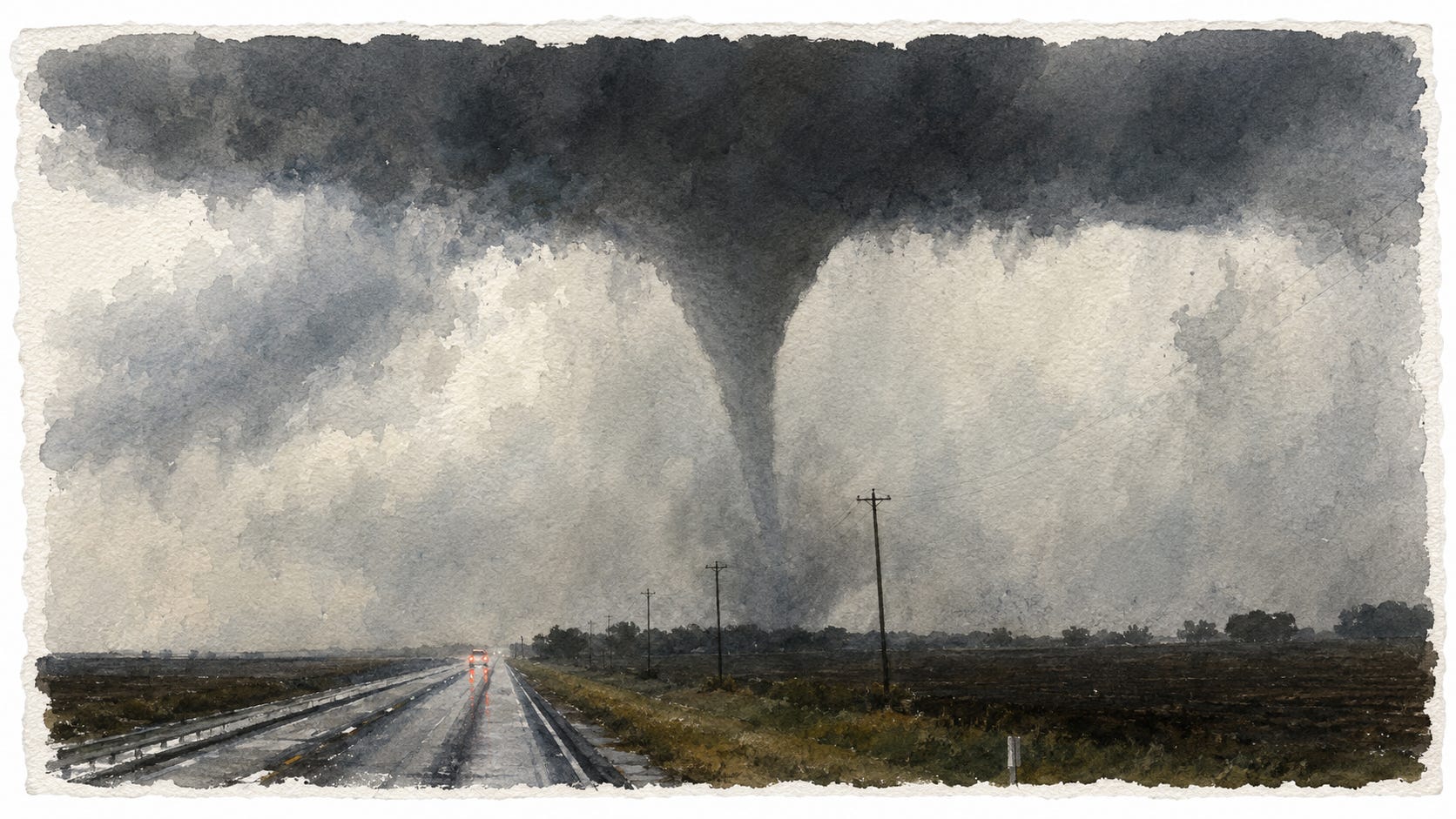
I find a video of Timmer intercepting the Appleton tornado and watch in horror as he and his crew become trapped on a bridge. The tornado is what chasers and meteorologists call “rain-wrapped”—churning up destruction while hidden by low clouds and heavy rain.
I’m on the verge of tears again. There is no obvious funnel in Timmer’s video. To an untrained eye, the tornado is nearly invisible.
They wouldn’t have seen it coming.
I press my cool hands against my forehead and cheeks. On the TV, Timmer is screaming—his signature move—that he sees debris, proof that the circulation has reached the ground.
Except YouTube’s captions hear something else. They say:
“TORNADO ON THE GROUND! WE’VE GOT DEBBIE ON THE LEFT! MAJOR DEBBIE!”
In a flood of absurd relief, I begin to laugh. I salute the TV and Reed Timmer, nodding respectfully as I say, “Major Debbie.”
And I know that once again, for now, tenuously—always tenuously—we are all somehow OK.
The view from inside Alex’s car in the aftermath. Photos by Olivia Baker, used with permission.


"You look into their eyes the moment they’re born, don’t you? And you realize with a fierce ache in your chest that they must outlive you."
Yep. The alternative is a black hole.