

At my musical theater group’s rehearsal this week, I took my seat in the alto section next to JJ. As we greeted each other, the conversation pivoted quickly from a friendly “Hey, how are you?” to something I’ve been hearing—and feeling—more and more as 2026 progresses.
“I’ve been in such a funk the last couple of days,” she said. And that’s one thing I love about certain people in my friend group: their openness.
“Me too,” I said. “Everything just feels so… heavy.”
“Exactly. Like there’s this looming sense of dread.”
“It’s oppressive, isn’t it? And we’re far from the only ones feeling it.”
It feels good to say these things out loud: Everything’s heavy. Looming dread. Oppressive. They’re the kinds of feelings we’re biologically wired to hide so we don’t signal weakness to the rest of the herd. Evolutionarily speaking, “I’m fine” is more than a polite response; it’s practically a reflex.
So, from the very get-go, JJ and I were breaking from the norm. When she said she’d been in a funk, she thwarted the “I’m fine” instinct and let herself be open. And that’s another thing humans sometimes do—we bond through vulnerability. (And see, that’s what my entire space here is about. We’re bonding!)
Although we’re programmed to hide weakness, sometimes we don’t. And that’s partly because we learn to hide it from the wrong people and the wrong contexts. Instead, we share with people we trust as a form of connection.
I thought about my exchange with JJ as I drifted off to sleep that night. I’ve always lived in my head, so sometimes it’s a challenge to listen to signals from my body, but as I lay there I made a point to acknowledge the sensation of a weight having lifted. My shoulders had dropped, my jaw unclenched. Warmth flooded me, and I smiled. The dread, at least for now, had dissipated with the realization that I have people in my life worth trusting. People I can mostly just be myself with and not fear judgment. That’s no small thing!
That moment was what what Deb Dana—a trauma-informed clinician, author, and lecturer who specializes in polyvagal theory—calls a “glimmer.” Here’s how she defines the term:
Glimmers are micro-moments of regulation that foster feelings of well-being. A glimmer could be as simple as seeing a friendly face, hearing a soothing sound, or noticing something in the environment that brings a smile. They are personal to each of us and one person’s glimmer may be another person’s trigger. Glimmers are a cue in the day, either internal or external, that sparks a sense of wellbeing. These tiny moments gently yet significantly shape your system toward well-being. They help you become regulated and ready for connection.
When I took a moment to recognize what that moment meant to me, to record it, and now to share it with you, I helped regulate my nervous system.
And we could all use a little more of that these days, couldn’t we?
A few things worth knowing about glimmers:
They’re micro-moments—small, quiet sparks of joy, safety, or connection. A friendly face. A soothing sound. Something that makes you smile.
They’re deeply personal. One person’s glimmer might be another person’s trigger.
Your brain is wired to notice threats more than gifts, which is why glimmers slip by unnoticed… until you start looking for them.
They’re not toxic positivity. Recognizing a glimmer doesn’t minimize your pain or tell you to count your blessings and move on. It just reminds you that your nervous system can hold both hard things and beautiful ones at the same time.
They accumulate. One glimmer won’t fix everything, but they add up, nudging your nervous system, little by little, toward regulation and connection.
The practice is simple: See the glimmer. Stop and feel it. Appreciate it. Remember it. Share it.
This week alone, despite the nagging hum of depression, the electric buzz of anxiety, and the stultifying weight of financial instability, I’ve logged glimmers. And I do notice them helping to lift the fog. Not dramatically, but incrementally, allowing me to keep moving, keep loving, stay standing.
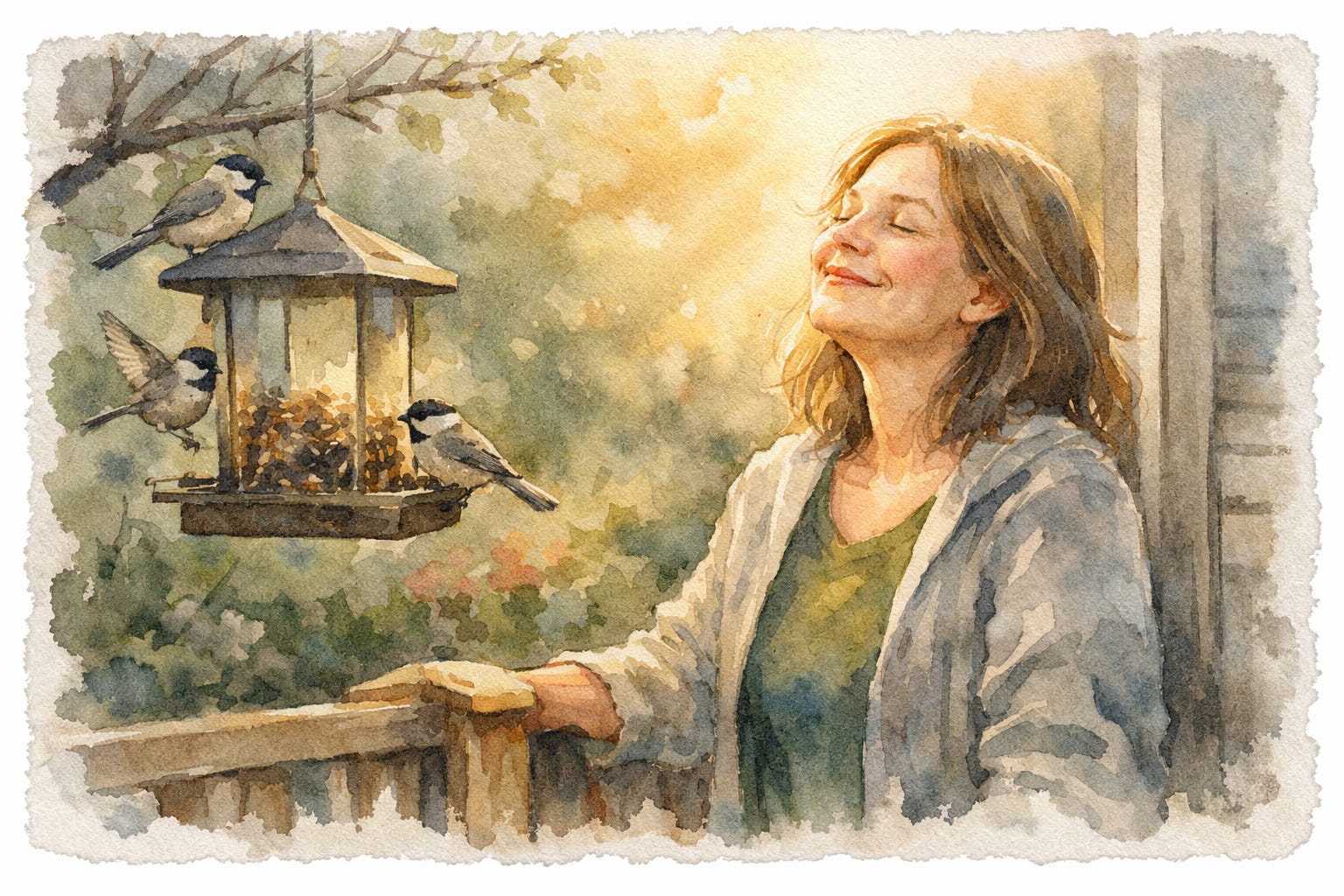
I noticed the chickadees and juncos queueing up in the hawthorn tree next to my back porch, waiting for me to finish filling the feeder.
I spotted big buds on my tulips and magnolia tree, ready to burst into spring color.
I watched violet green swallows swoop and dive under my eaves, performing an air ballet as they sought out a place to nest.
I breathed in the heady scent of freshly turned soil as I planted the red flowering currant shrub I never got around to planting last season.
I celebrated the first pink clusters of blooms on that shrub just days later.
I recognized my daughter’s kindness when I forgot to close up my cold frame on a chilly night and they did it for me because they’d noticed a frost warning on their weather app, saving my San Marzano tomatoes from certain doom.
Noticing those little moments has helped to prevent me from spiraling into despair as our world seems to spin more and more out of control. And although the moments are small, the impact of paying attention to them isn’t.
The world is a lot right now, and it's okay to say so. But while you're in it, keep one eye open for the glimmers. They're not a cure. They're not even a consolation prize. They're just proof that your nervous system still knows how to feel something other than dread — and that's worth paying attention to.
So that’s my invitation to you this week: don’t wait for things to get better before you let yourself feel good.
Every week, I share two creative nonfiction stories with my readers—thank you so much for being one of them! Paid subscribers to I’ll go first… get a writing prompt every Friday as a thank-you for supporting me and an invitation to join me in a journey of self-discovery through writing. You can come along for just $5 a month!
