


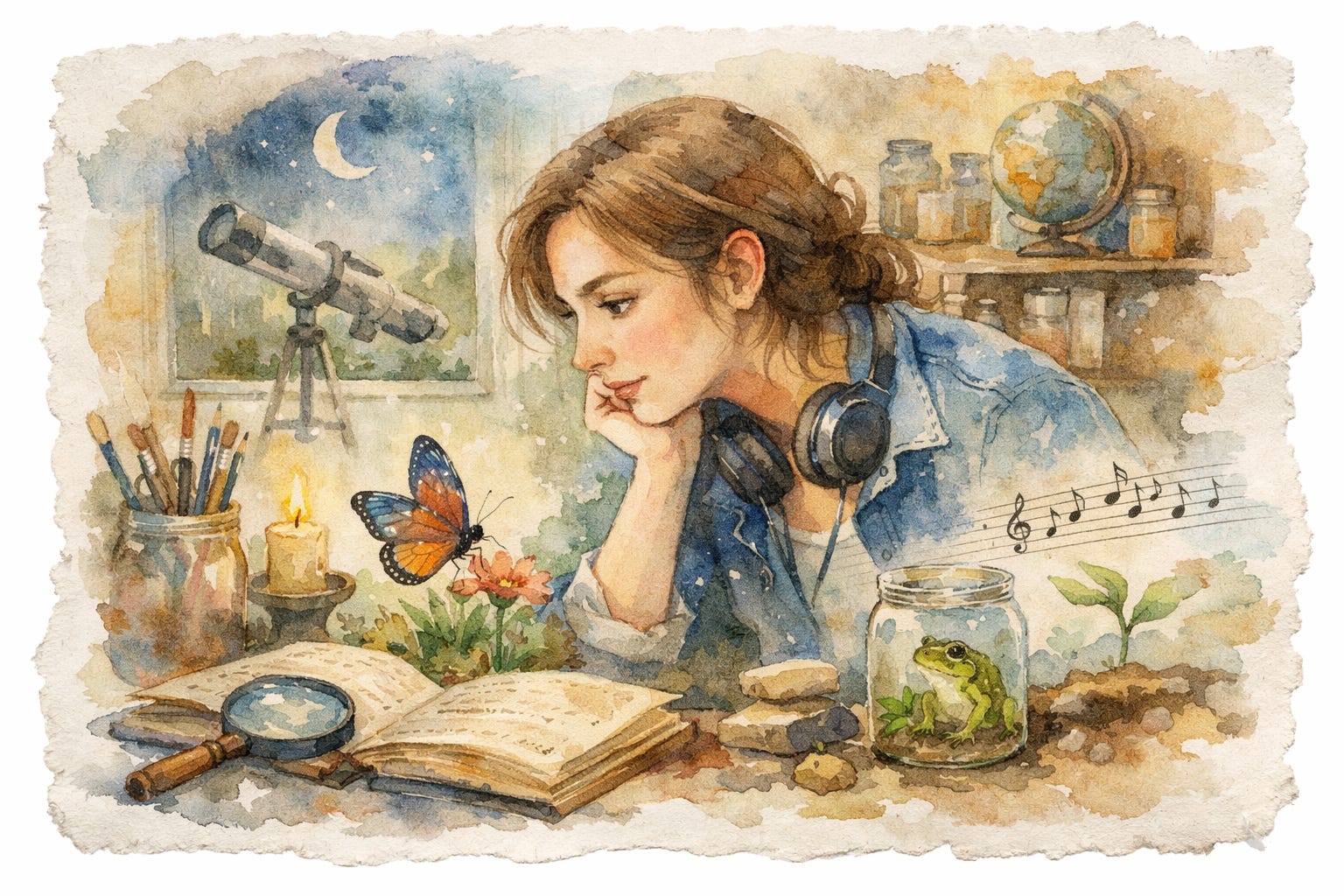
Today is one of those Fridays.
I feel a little overwhelmed, a lot exhausted, and just generally not in the mood for writing. Or, if I’m honest, for much of anything that doesn’t involve sitting around watching YouTube videos about gardening (which is easier to do than actual gardening) and eating a handful of honey mustard pretzel chips while sipping tea.
And yet, here we are. Because an idea came rolling in at the last viable second, as ideas often do.
Remember how people always ask you how you play piano by ear and you say, ‘I dunno; I just do”? That’s a ridiculously unsatisfying answer. What if you got curious?
What if, indeed.
So, I went down a mental rabbit hole. I sat down at my Yamaha keyboard (and in case you’re already getting curious, it’s this one) and started playing. I didn’t plan to play any song in particular, just whatever came out.
First up was “Feels Like Home” by Randy Newman, a song I love to sing that reminds me of my beloved and departed John. Then I fired up the pipe organ sound setting and quickly figured out how to play the theme song from How to Train Your Dragon.
Because of course I did.
And then I just plunked around. Except that my “plunking” tends to come out as fully formed songs. Songs I could, if I wanted to, shape into something with lyrics.
And yes, sometimes it feels like magic. For me, music just happens. And I realize that it’s a clever combination of genetics and neurodivergence (super-duper pattern recognition skills!) that other folks may not have. Or may have in far more abundance than I do. But it struck me just how meta my “getting curious” at the keyboard actually was. Because I think, in large part, I have curiosity to thank for my abilities.
When I was five, my mom’s Magnus chord organ—a little plastic thing that sounded like an unholy cross between a harmonica and a vacuum cleaner—ended up at my grandparents’ house, where it stayed on top of the cedar chest in my great-grandmother’s tidy bedroom.
And one day, five-year-old me got curious while visiting Grandma’s.
I turned on the chord organ, it wheezed to life, and I started pressing keys. First, I played scales. Then—Oh! How interesting!—I realized that I could press two or three keys at once and if I spaced them at even intervals (C-E-G, although I didn’t have a name for those notes or that chord yet) they made a beautiful sound. Or at least as beautiful a sound as a Magnus chord organ could make.
I discovered chords through the power of curiosity.
And then I picked out notes and quickly discovered that I could play “Twinkle, Twinkle, Little Star.” (Playing a theme written by Mozart at age five? Total prodigy, amIright?) The Magnus had little chord buttons like an accordion, so I explored and figured out that certain buttons matched certain phrases in my song. Fun!
Later, “The Entertainer” was all over the radio airwaves (at least in my grandparents’ kitchen) because of the movie The Sting. I was curious: Could I play that?
Yep, I could. And I did. I even played it at a school talent show (which I don’t recall winning, so maybe it wasn’t very impressive, but still.)
As I got older, I experimented with chords. Before I knew what they were, I was adding ninths and sixths and suspensions. (If I’m honest, I still only kinda know what they are. But it’s fine, because I’ve got the practical application down if not the theory.) And these days, I can sit down and write a song and it just sort of comes out whole.
Or not at all. As I’m sure you know, there’s plenty of “or not at all” that artists of all kinds experience.
Curiosity, to me, feels like an essential element. In a world full of judgment, curiosity is the antidote. You simply can’t judge someone or something when you’re curious about it because you’re fully aware that you need more information—sometimes much more—before you form an opinion.
So, what does curiosity look like in practice? It’s like this:
Someone says something you immediately disagree with. You could express your disagreement, or you could ask, “What led you to that conclusion?”
A friend makes a choice you don’t understand. You could judge them, or you could ask, “What made this feel like the right decision for you?”
A coworker offers up a solution you believe is totally impractical. Do you shout down their idea or ask, “What problem are you trying to solve with this?”
And here’s a big one: Someone you know and care about holds a political or social view different from your own. Do you join the culture wars or ask, “What experiences shaped their perspective?”
And now, after all this curious fun, I’m going to challenge you with a tougher-than-it-looks writing prompt.
For my free subscribers: This is where we part ways for the week. Thanks for hanging out with me.
If you’d like weekly writing prompts to help you think, grow, and create, consider upgrading. You’ll get the full archive plus access to our community. Permission to get uncomfortably curious about yourself and the world around you.
See you next Friday!
