


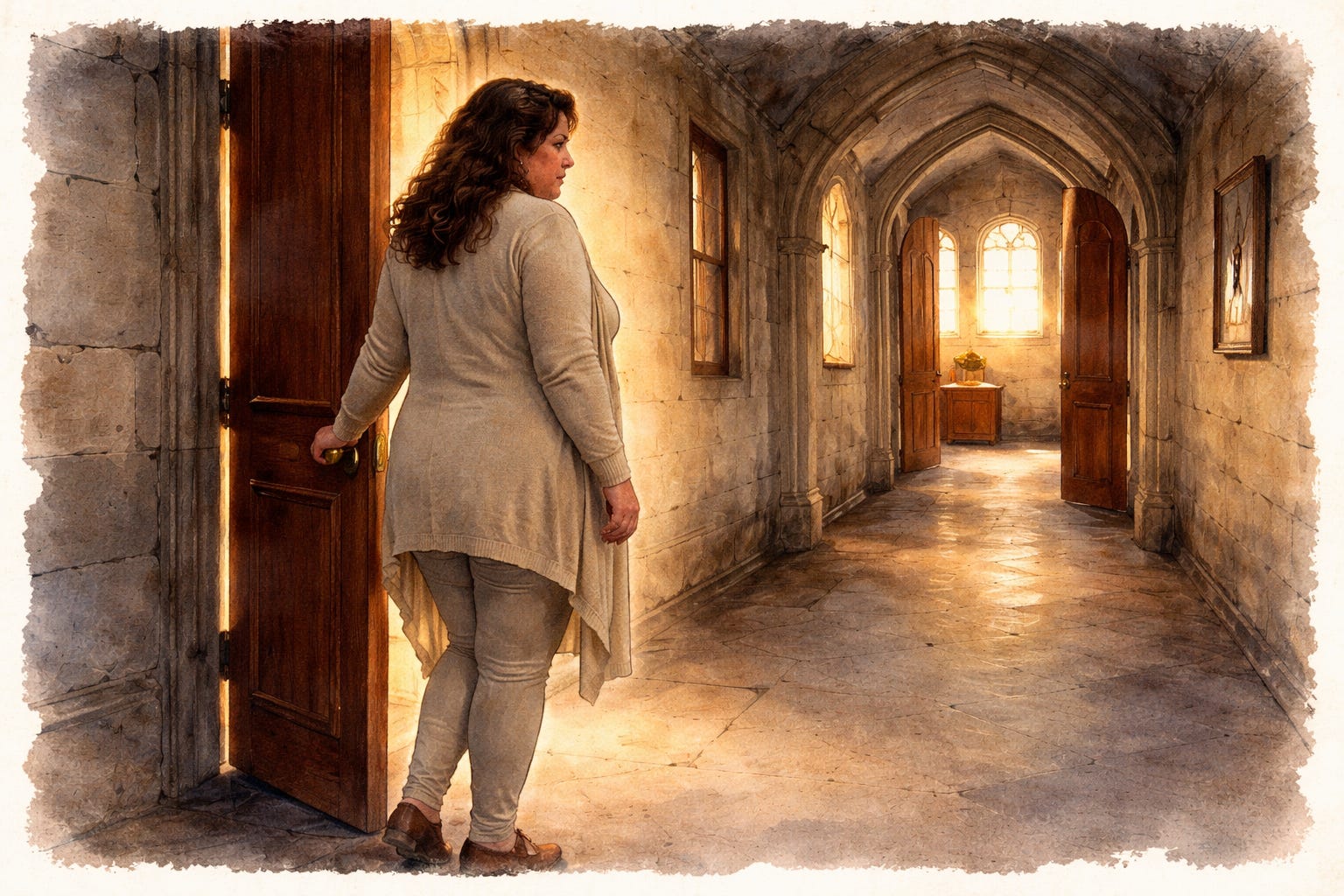
I’m sitting beside Peggy in the cramped office of the downtown Episcopal church. The one on a small peninsula that juts out into the lake, built in the 1880s, with the beautiful stone gothic architecture.
Peggy’s acting odd: Shifting in her seat, offering pinched smiles. She’s hesitant, where before she’d trained me for my new job as church secretary with enthusiasm.
Great. I’m about to lose this job, aren’t I?
Right on cue, Father Gerald pokes his head in the office door. “Karen, can I talk to you for a moment in my office?”
I sit down in the priest’s tidy office. He’s a wiry man, probably in his 60s. Tanned and leathered from years outside in the sun. He radiates the sort of health my own father always wanted me to aspire to—the rugged, outdoorsy kind. I can still hear my dad observing, as he assessed my pale skin and soft body, that I “wasn’t much of an outside girl.”
And I’m not. At least, not in the sporty way my dad hoped I’d be. I love to walk in the woods and daydream. I also love walking at night, when lights glow softly from homes and I can imagine the lives that might be happening under those roofs. Are they happy? Troubled? Is there someone in there like me, quietly reading in her room, ashamed of not being an “outside girl,” too?
Father Gerald takes a seat and pulls his chair up close to the desk, flat against his firm abdomen. He folds his hands on the blotter in front of him.
“This is hard to talk about. Peggy tells me you’re doing an excellent job. She likes your work and how quickly you learn.” He gives a humorless chuckle. “So, she’s a little upset with me right now.”
I blink. Tilt my head. Say nothing.
Father Gerald clears his throat. “So, I have a problem with overweight people. I thought I could overcome it when I hired you—you came so qualified and highly recommended—but I can’t.”
Heat climbs up my neck and blooms scarlet across my cheeks. I continue to say nothing. I’m waiting for him to get to the point, performing “fine” when inside I’m overcome with the sort of humiliation that feels like a punch in the gut.
“I’m sure you’re a lovely person. But I think— Well, I feel—” he wrings his hands and clears his throat again. “I feel if a person is fat they have some unresolved issues. Mentally speaking. There’s something going on if you need to eat so much, right?”
I draw in a deep breath. For a moment, I’m not sure how to respond to him.
I’ve been called “fat” my whole life, even when I wasn’t overweight. Something about my height (tall), my rounded back and shoulders, and my soft belly made me ripe for judgment from the very first doctor’s appointment I remember. The one where the pediatrician told Mom I had a “spare tire.”
And it’s true the only time Mom was delighted by my appearance was when my high school girls’ gym class had a weight management segment that spurred me to starve myself down two sizes by eating 400 calories a day for a month.
And yet, never had anyone fired me for being plus-sized. In fact, I’d never been fired before at all.
Now, in that sunlit office with its leaded glass windows, I fight the urge to collapse into tears. Instead, I summon the courage to draw back my shoulders, lift my chin, and say, “I believe you’re the one with unresolved issues. Mentally speaking.”
Father Gerald sighs. “Yes,” he says, “You may well be right about that. But nonetheless.” He pushes a paper toward me to sign, my notice of termination. “I just can’t have you here, you see? Every time I see you, it reminds me of this… repulsion. And when you wear those stretch pants—”
“Stirrup pants.”
He corrects himself, “The stirrup pants. They… just make your weight problem more obvious and I—”
I sign the paper and stand up. “It’s fine,” I say brusquely. “I don’t want to work for someone who can’t stand the sight of me.”
I walk out and shut the door firmly behind me, then stand there in the hallway for a moment, stunned. Did I really just say that? Did I really tell an Episcopal priest he had mental health issues? I tremble with the realization that I’ve done something so outside my comfort zone. Normally, I’m the one who quietly absorbs criticism and processes it into self-loathing.
I head back to the office where Peggy awaits. When I walk in, she looks at me with pursed lips, eyebrows knitted together in dismay. Her concern is genuine, and I fight back tears as I say, “It’s been nice working with you.”
Peggy stands and puts a hand on my shoulder. “You were doing really good work, Karen. Believe that.”
Peggy’s miserable. She drops back down into her office chair and clutches her forehead, as though fighting a headache. “It’s all him, you know,” she says. “I care about him. He’s a good man. But…”
I want to say, Can you be a good man if you’re also a bigot?
But I don’t. Instead, I shrug, shake my head, and say the words I’ve grown to hate: “It is what it is.”
* * * *
I’d felt good in those cream-colored stirrup pants and the creamy knit duster I wore with them, the one with the pearlescent buttons and tiny sequins. Pretty, even. But after that humiliating day in the Episcopal church office, I stopped wearing anything stretchy. I stuck to jeans (or buttoned dress slacks for work.) So what if those waistbands always seared a red stripe across my tummy where they dug in. Beauty is pain.
For 30 years I just dealt with discomfort. “It is what it is,” right? Plus, it wasn’t so bad. That red stripe faded by morning, just in time for me to start the process all over again.
But then one day I found myself in Old Navy in search of yoga pants. Just for slopping around at home, not for going out in public, I told myself. I pulled on some high-waisted pants and—holy shit! They were beyond comfortable. They didn’t dig in anywhere. And was it just me, or did they actually look—
“Those look nice! They’re slimming,” my daughter said when I put the yoga pants on at home.
“Like, nice enough to go out in public?” I asked.
“Yeah! They look good on you. You could wear them anywhere, with anything.”
I went to the full-length mirror in my closet, the one I almost always avoid because who wants to look at this body? My kid was right—the yoga pants looked good. Slimming, even, with no “muffin top” to roll over the waistband. And beyond that, they were the most comfortable pants I’d worn since, well, late-90s stirrup pants.
And with that, I chose to wear my yoga pants all day every day. Work, shopping, a concert, a dressy event—the right kind of yoga pants (like the ones I have made from a shiny knit fabric) can be dressed up, I’ve found. Nobody needs to know that waistband doesn’t have a zipper and a button.
Father Gerald, if he’s still among the living 30 years later, would probably hate my yoga pants or, more specifically, hate me wearing yoga pants. And honestly, that thought brings me more satisfaction than it probably should.
Here’s what I know now that I didn’t know then: comfort isn’t a consolation prize. It’s not what you settle for when you’ve given up. Comfort is what you earn when you finally stop punishing your body for existing.
Those stirrup pants made me feel pretty. These yoga pants make me feel like myself. Turns out those two things can be the same thing, and no leathered priest with unresolved issues gets a vote.
I share two vulnerable, relatable creative nonfiction stories every week — no paywall, no gatekeeping. If you’d like to throw a little support my way, a paid subscription is just $5 a month, and I’ll send you a weekly writing prompt as a small thank-you. (There’s also a chat community where you’re always welcome to share your thoughts or your own writing.)
Paid subscribers, scroll on for this week’s prompt. Stay strong and write on!
