

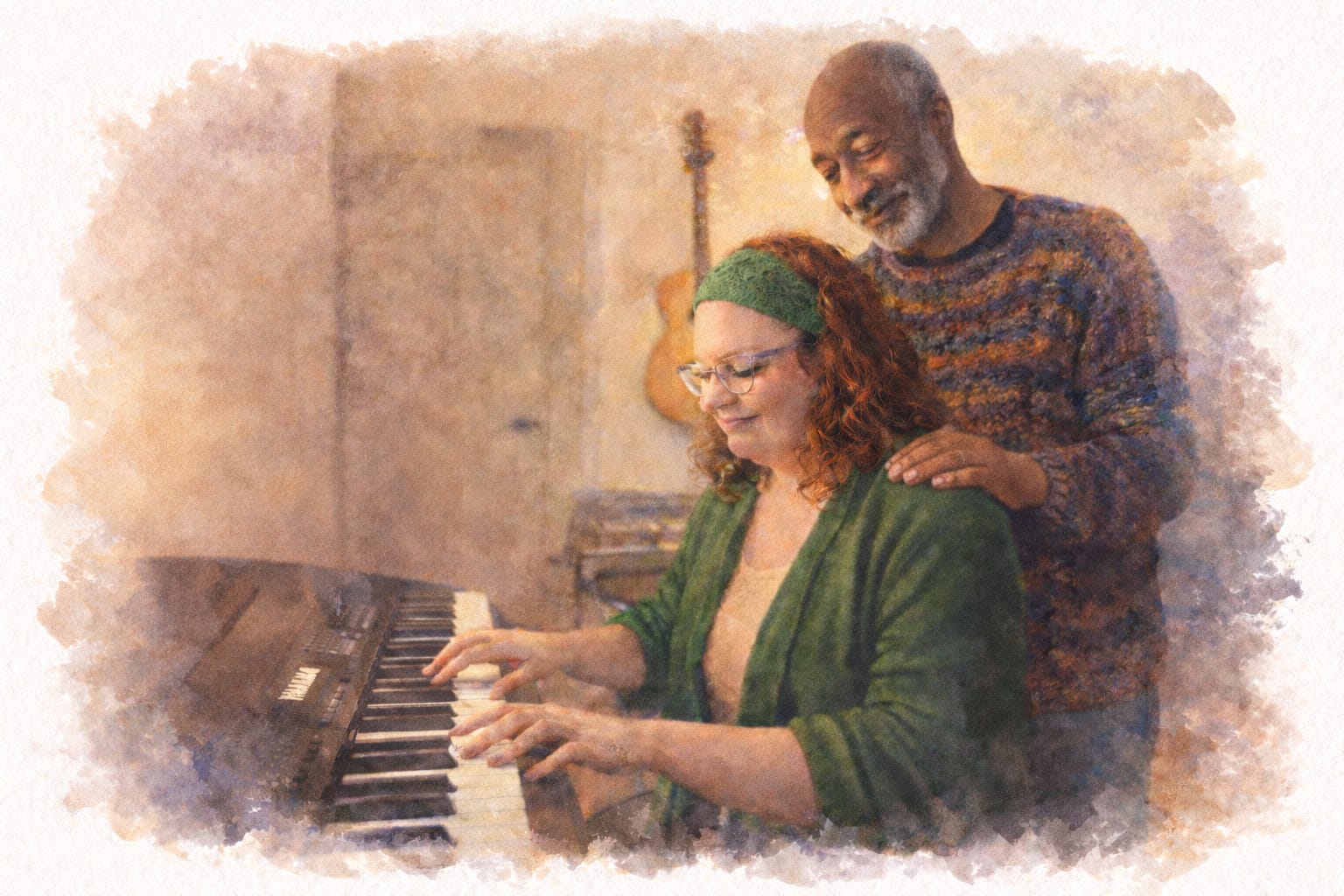
My hands flow instinctively across the keys, playing a melody I’m composing on the fly. It’s what I do, my secret superpower — I sit at my Yamaha and songs come out. Sometimes, they stick.
I’m just killing a little time while John washes up after our dinner date. I hear him saunter up behind me, humming along with the piano.
“Lovely,” he says, resting a hand on my shoulder. “What are you playing?”
I keep playing, shrug, and say, “Just fucking around.”
“Just fuuuckiiin’ arooouuund!” John sings. In perfect tune with my keyboard stylings, because that’s his superpower.
John and I have music in our souls.
I laugh and stop playing, then turn my eyes upward to gaze at the man standing beside me. His brown eyes shimmer in the dim light. He offers the smile I know is especially for me, one that conveys love wordlessly.
A thought enters my head and I tense. John feels the tightening in my shoulders. He tilts his head with a gentle inquisitiveness that tells me the floor is mine if I want to talk.
“I wrote a song,” I say, my words spilling out in an anxious jumble. “I was … inspired. I wrote it for the choir. I thought maybe Kerri Lynn would want to arrange it and use it.” I worry my eyebrows together and cast my eyes toward the floor as I murmur, “She probably won’t. But … do you want to hear it?”
I don’t perform for people. At least not readily. I’m slowly becoming better at it, but I have to push myself. Every time.
Before self-reflection and study led me to become agnostic, I played the organ for my family’s Catholic church. My grandpa, who was my person and champion, recruited me at age 15 to accompany the tiny church choir. The regular organist was a sweet woman with a gorgeous voice, but she also had, according to gramps, “a bit of a drinking problem,” which led to a bit of an attendance problem.
I protested, because the only music-reading skills I possessed came from a couple of years in middle school band. I was a mediocre clarinet player, but I came away with a passing understanding of timing and I could read treble clef well enough. Otherwise, I played keyboard instruments almost entirely by ear.
I played pretty well by ear, actually. But that was a far cry from accompanying a whole choir and playing for a church filled with 200 or more people.
“I told Father Murphy you’d do it,” Gramps said. “He was over the moon. And they’ll pay you $35 a mass and $25 for each rehearsal.”
I quickly did the math. At the very least, I’d make $240 a month. And for a 15-year-old in 1982, that didn’t suck.
So, I became a church organist. And I eventually fell in love with playing for both the choir and the congregation. But I never saw myself as competent. Every musician I encountered when I played at church — from wedding musicians to other organists — gave me a look as though they’d just smelled something nasty when I confessed I had no formal training.
“How do you even play, then?” the Real Musicians would scoff.
“Um, I … just do? I rely on the chords.”
“Like a fake book?” they’d ask, scandalized.
A fake book is a music book (usually spiral bound) that includes lead sheets—songs with just a melody line, chord symbols, and lyrics. They’re intended for musicians who want to create their own arrangements or improvise around the basic structure of a song. They’ve traditionally been popular among jazz musicians, because for them, improv is where it’s at.
And for me, too. I improvise.
I played for my family’s church for 17 years. But when the parish moved to a brand new building, the church leadership decided they needed a brand new organist who could also serve as music director. Someone with a music degree.
In other words, not me.
I felt rejected and inferior. Sure, I could play a decent approximation of any song I heard, and sure, I could sing, but what for? Where had it gotten me?
I wasn’t a Real Musician. I was a fraud.
It would take many years for me to find my musical voice again.
* * *
“Let’s hear it,” John encourages.
I take a deep breath, hold it, release, let my shoulders drop, close my eyes.
And then I play. The song is in a lilting 3/4 time with an intro that, to me, sounds vaguely Celtic.
John knows me. He loves me. Our relationship is intimate and profoundly deep. And yet, I still tremble as I begin to sing for him.
One lone voice
Like a whisper on the wind
Carries one soft song
And the melody spins
Into the dawn
Where the starlight grows dim
Lifting one lone voice
One soft song
John’s hand caresses my shoulder, soothing. I play the instrumental interlude and continue.
One lone voice
Wakes the dawn with gentle tones
And then one lone voice
Is no longer alone
Two now sing
And raise the joyful tune
Singing harmony
In one sweet song
I continue on through the final verse, and then turn to John, my smile more of an anxious grimace. He’s a brilliant musician, if not a trained one. Although his musical tastes are broad, in the few months we’ve been in love, I’ve never known him to listen to this sort of music. I’m afraid he won’t like my song, and even more afraid he’ll be honest about it, because that’s who he is.
John’s expression is so soft it’s practically liquid. “It’s beautiful,” he says. “Thank you for doing me the honor of being the first to hear it.”
I blink back tears. This is the validation I need, and it’s made all the more valuable because I know it’s sincere.
I had toyed with the idea of sending One Lone Voice to our choir director. John and I met as members of the Peace Choir, and my second year as a member had not only brought John into my life, but also helped me to realize that I now had a musical tribe — a vast collective of welcoming, open-hearted, genuine people I cared about, and who cared about me.
“I wrote this for the choir,” I say. And then I look up into John’s eyes. “And for you. The second verse — ”
His eyes crinkle again. “I know.”
John listens as I debate with myself. I was going to send it off to Kerri Lynn, I say aloud, but it’s not arranged for a choir. She’s not only a choir director but a composer, so she would have to arrange it. Which, of course, is a lot of work. And she probably won’t want to do that, because it’s just a silly song and who am I to think I could compose a song for a whole choir? Besides, she probably has enough of her own compositions to work on. And she teaches workshops in the summer, so she’s busy. So, yeah, no, this is—
“You’re probably right,” John says. “Kerri Lynn does like to perform her own music. You don’t have to send it if you don’t want to. We know it’s a beautiful song.”
John knows me. He knows that although I’m often quiet and reticent, I also have a mile-wide defiant streak. He later confesses that he knew exactly what he was doing when he told me “you don’t have to send it.”
That night, after John goes home, I record myself singing One Lone Voice. In the morning, I write an email to Kerri Lynn. I send her the recording, tell her I wrote the song for the choir, and suggest that she totally doesn’t have to do anything with it but if she thinks it’s worthy I’d be honored if she’d arrange it for the choir.
Later that day, I get a response.
She loves it. And yes, she wants to arrange it.
Although it was written for the beloved choir I joined when I moved to the Pacific Northwest, One Lone Voice is ultimately the first (though not the last) love song I wrote for John.
Wherever we went together, John and I sang. We harmonized. We laughed. We loved with every piece of ourselves. Both of us had been excruciatingly lonely until our stars finally converged and we found one another. No longer alone, we “raised the joyful tune,” celebrating life and connection.
In the spring of the next choral season, the Peace Choir debuted One Lone Voice to a large and enthusiastic audience. Choir members hugged me and told me the song stuck with them long after the performance, following them to bed at night and lilting through their dreams.
I’m still hesitant to admit this, and especially to say it aloud, but maybe I’m a Real Musician after all.
This is the debut performance of One Lone Voice, written by Karen Lunde (me!) and arranged by Kerri Lynn Nichols. It was performed by The Olympia Peace Choir. Me on the vocal solo, Kerri Lynn Nichols on recorder, Yonit Yogev on flute.
Thank you so very much for sharing your most beautiful and special song you composed and allowed us the honor to perform. It has always been such a treat singing together and enjoying how you create music since we both began as Sisters of the Magnus Chord Organ beginnings, lol! You my dear have taken your love of music so far and I cannot tell you how fun it is hearing you perform and seeing you grow your business. All the best to you in the coming years!
Powerful! Beautiful! I, like you, have told myself I’m not a real musician. I play piano, I read music, I memorize some of what I play, I even perform casually, but my brother has always been the talented one, not me. I am glad that you realized you are truly talented, a real musician and a fine one! I loved listening to your song performed by so many voices. It made me want to sing in a choir again. It made me want to work on that song I started composing about 40 years ago. If I ever do finish composing that song, I might actually believe I have musical talent… 🎶 Keep writing music and words and keep singing!🎵