


From where do writers draw their creative powers? From their muses and… your subscriptions! Consider becoming a free or paid subscriber today.
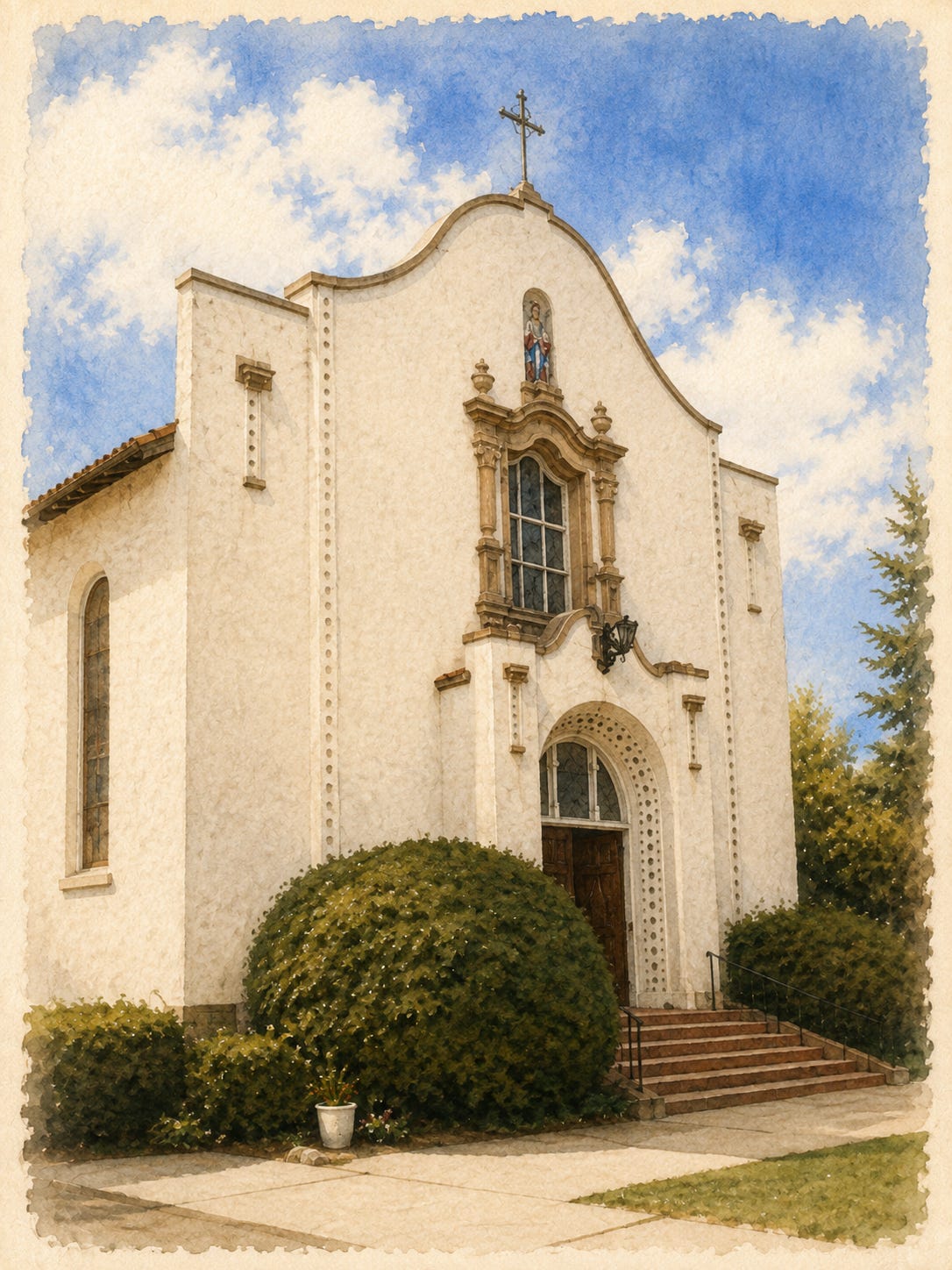
It’s July, and Saint Joan of Arc is a stucco-clad oven.
Grandma has made us get up early for 8 o’clock mass. It’s cooler in the early morning, she says. But a hot, humid Saturday had baked the old Spanish Mission-style building beneath hours of unrelenting sun. The church had held onto the stifling heat overnight.
I jump up to help Gramps, who is surely already sweating in his emerald green usher’s coat, open the small vents at the bottom of each stained-glass window. Tug a little chain, gently tilt open the vent, attach the chain to a hook. The tall windows depict the Stations of the Cross. As I open each, I recite the stations I’ve learned in catechism:
Jesus is condemned to death.
Jesus takes up his cross.
Jesus falls for the first time.
I wonder why ours is a religion that celebrates anguish.
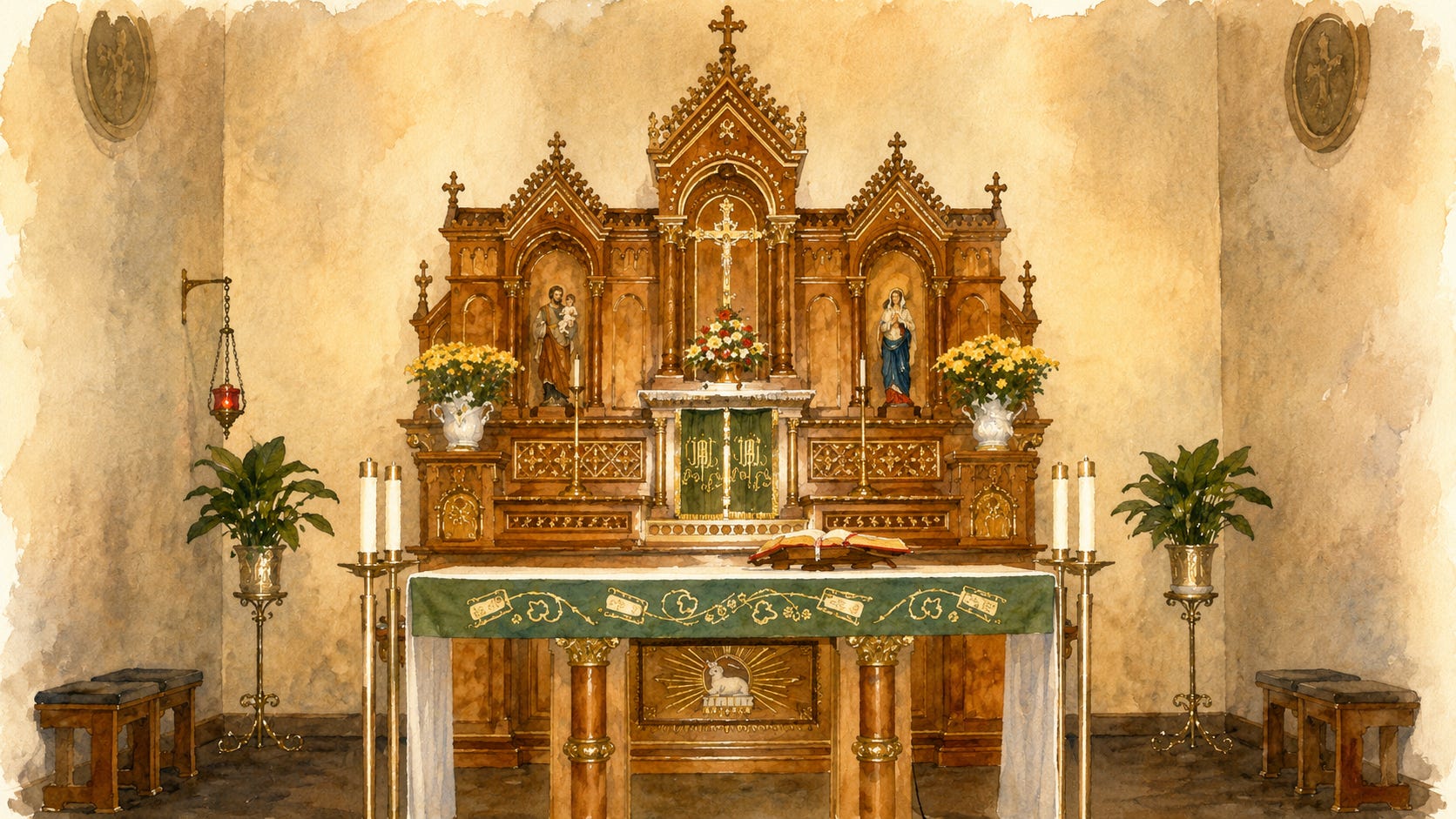
Life-sized statuary flanks the altar. On the right, Saint Joan of Arc, clad in armor, stands defiantly, her helm in one hand and a flagpole in the other, where a white and gold fleur-de-lis banner waves in a nonexistent breeze. I know Saint Joan was put to death. Images of her being burned at the stake decorate the parish hall and school.
On the left, a gold lamp shines its beatific light down on a portrait of the Virgin Mary holding the infant Jesus, who almost appears to be standing on her lap. The pair stare solemnly out at the congregation from their gilded throne, each head surrounded by a halo. The infant Jesus raises his hand in a gesture resembling a peace sign. But above the altar, not far from that peaceful scene, hangs an enormous cross where Jesus, no longer an infant, hangs. The crown of thorns piercing his head, the spikes puncturing his hands and feet, and the gaping wound in his side all ooze blood.
It seems cruel, I think, to have Mary and baby Jesus in sight of this horrific tableau.
After helping with the windows, I slip back into the pew next to Mom and Grandma. I ask to see the bulletin Grandma is clutching. I don’t want to read it; I already know it’s going to say: pray for So-n-so, give money to the building fund, get the best meats at Pernat’s, bury your dead with Pagenkopf Funeral Home. So I pretend to read it for a moment, then use it to gently fan myself. Mom smiles and gestures that I should send a little breeze her way, and so I do. We giggle when her bangs fly up with each flick of the bulletin, waving like a floppy brown flag in a gentle breeze.
Grandma shoots us a glare. Even though the mass hasn’t begun, we’re supposed to observe silence. People pray before mass, don’t they?
Enter the sanctuary. Greet the ushers. Receive a bulletin. Choose a pew. Genuflect. Sit. Lower the kneeler. Kneel. Make the sign of the cross. Pray. Make the sign of the cross again. Sit quietly while everyone else prays.
Do not rest your butt on the pew while kneeling. This is not proper.
I watch Gramps walk up the side aisle toward the sacristy. Past the Madonna-and-Child. Past the lectern, where Gramps often reads from the Bible in his commanding voice. Past the altar. Into the little room where the priest and altar boys are gathering to don their vestments and prepare for the eucharist. Out the back door to the place that excited me so much when I was very small—the bell.
At every mass, Gramps rings the bell. Twelve chimes for the 12 apostles, he says. Gramps and I both love the bell. It’s second only to the carillon at the Lutheran church in Grandma and Gramps’s neighborhood. That set of bells actually plays songs that ring out across the landscape at 5 o’clock every evening, many of which Gramps loves and hums along to.
Just as I am, without one plea
But that thy blood was shed for me
These songs about blood and dying and sacrifice intensify during Lent. Then, we’ll sing things like, “O sacred head surrounded / By crown of piercing thorns.”
Which is fun for exactly nobody.
When I was smaller, I would pretend to be asleep on Grandma’s nubby salmon pink couch when it was time to leave for mass. If I breathed heavily enough and looked precious enough, Mom might tell Grandma I was so sound asleep that she didn’t want to wake me. She would stay with me, she’d say, and everyone else could go on without her. Then, after everyone was gone, Mom and I would celebrate not having to go to church.
We were subversive like that.
And we got away with it exactly twice before Grandma caught on.
My uncle Richard’s family often comes to visit during the summers. Because they live a couple of hours away in Manitowoc, where my uncle is stationed in the Coast Guard, when they come, they spend the weekend and go to church with us.
Having my cousin Richie in church with me spells trouble. Because there’s no one in the world who can make me laugh more than Richie.
They’ve taken separate cars, of course, but now Uncle Richard, Auntie Linda, and my cousins Richie and Joey, arrive and scooch into the pew beside us. I see Grandma lift her chin with pride—her family now occupies one whole pew.
And Richie is seated beside me.
The little bell beside the sacristy rings and the organ begins to play. We’re not supposed to look back at the organist, but I do. A few weeks ago, Gramps had taken me into the choir loft to meet him. Louis Sticks was a large man with a large laugh and kind, sad eyes. He let me have a seat at the organ—intimidating with its vast span of pedals, two manuals, and multitudes of stops—and invited me to play.
I played the first song that popped into my head: The Entertainer.
Could I play another, Louis asked?
Yes, I could! I played what every kid with access to a piano knows how to play: Heart and Soul. Just the bumpa-dee-dee part. And Louis jumped in with the melody. I was enthralled.
And embarrassed. Why hadn’t I thought of better songs to play? Who plays The Entertainer and Heart and Soul in church?
Heathens, that’s who.
A couple of decades later, I would be sneaking instrumental versions of songs like Erin Shores by The Corrs and God Help the Outcasts from The Hunchback of Notre Dame into my communion interludes as Saint Joan of Arc’s primary organist.
I was subversive like that.
But now, I had to endure sitting beside my cousin, whose sole objective would be to make me laugh. We have Father Konkel presiding today, and as he drones through his soporific homily, Richie imitates his subtle gestures, moving his lips to make it look like he’s the one doing the talking.
It sends me into a fit of giggles I try to hide with my sleeve. Richie snickers and fidgets beside me. And somehow, mass gets just a little less dull. But afterward, the man seated behind us takes us both by the shoulders, painfully grasping the backs of our necks, and lead us into the sacristy to tell Father Konkel of our misdeeds.
Father listens, nods solemnly, and then, when the man who ushered us up to the sacristy is gone, he smiles, pats us, gives a wink, and sends us on our way, telling us to be sure to pay more attention next time.
Years pass. At 15, I become a Saint Joan of Arc organist. Later, I will lead the music ministry for a time. But then, after I serve as organist for 17 years, the pastor will decide the church needs someone with a music degree, a musician whose education is more advanced than someone like me who plays by ear and learned to read music by way of middle school band, EZ-Play songbooks, and cardboard cheaters placed over the keys.
At 15, we also go to visit my cousins, and this time my uncle is stationed in Montauk, on Long Island. Grandma insists we go to mass, but my uncle’s side of the family isn’t really into it and opts to stay home. (“Heathens!” Grandma proclaims.) Scott is 11, and Dustin is five, so they get to stay home, too. But Mom and me? We have to go.
My uncle lives in East Hampton, so we go to the nearest church, Most Holy Trinity. And once again, it’s hot. And once again, the windows don’t open much. So we sit in the back, closest to the open doors where there’s a slight breeze.
By this time, I’m an organist. I have a better sense of the order of worship and how a mass flows together. So I’m not even looking at the missalette when the responsorial psalm begins. It’s a call-and-response—the lector reads the verse, and the parish responds with a brief repeated line. Sometimes the verses are sung by a cantor, but in this case, we’re saying the response together in a cheerless monotone:
“If today you hear his voice, harden not your hearts.”
But we’re also in New England, surrounded by New Englanders. So the psalm response sounds more like:
“If tahday ya heah his voice, hahden naht ya hahts.”
And it is so ridiculous, so other to our Midwestern ears that Mom and I burst into peals of laughter. We attempt to silence it, but the laughter continues to bubble out. People turn to glare. Hunched, hands covering our embarrassed and still-laughing faces, we tumble out of the dim church and into the light of a bright July day. Grandma, all five-foot-two of her, comes stomping out after us, and her glare is even more severe than the one the Most Holy Trinity parishioners had given us.
“Youse two!” she bellows, in fluent Wisconsinese. “Such foolishness! You’d think you’ve never been in a church before.”
But Mom and I are still laughing. We turn to each other in unison and say, “If tahday ya heah His voice, hahden naht ya hahts!” And then we’re gone, doubled over with laughter.
Many years later, as a young mom myself, locked in a relationship with a troubled man, I will have an awakening. I will realize that my sole reason for embracing religion and Catholicism at all is that it was handed to me: Here, this is what we do. This is what you will believe.
Except that I no longer believed it. I had read the Children’s Bible given to me at my First Communion, and I had played the hymns, and I dutifully responded to the responsorial psalms, eventually learning not to smirk at “If today you hear his voice…” But although the nostalgia, the pageantry, the ritual belonged to me—became part of me—the faith did not. It had never been mine to begin with.
But I have much that I will keep. The memory of opening the vents on those stained glass windows, the statuary, the sacristy that felt like a forbidden place where only the holiest should go, the bell, the organ, the choir, the hymns.
Especially the organ, choir, and hymns.
And I will always be the subversive laughing in church.
Sharing is caring! If you know a fellow subversive who would totally laugh in church—or maybe even a current or “recovering” Catholic with a sense of humor—please send this to them. You might make someone smile while helping my channel grow. And that’s pretty dang nice.
The worst punishment my brother and I ever got was for misbehaving in church. It was sheer torture to be inside on summer days--I could see a tantalizing patch of sunshine through a small window at the back. Even then, I knew I'd personally feel far more worshipful outside in the creation than I'd ever feel in a stuffy church building.