


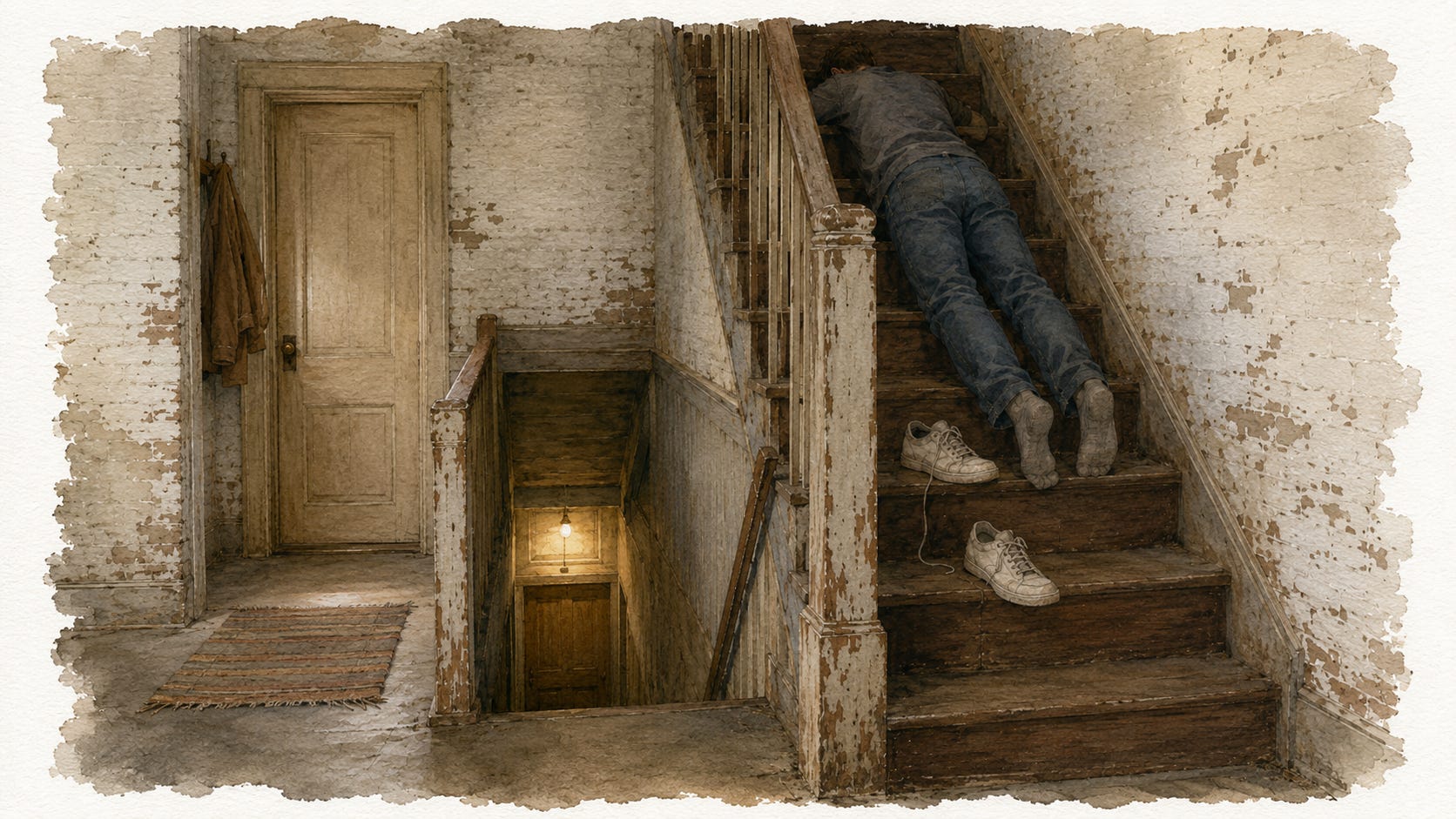
Mom walks up and leans in the passenger-side window. Her tone is calm, her register low, as she nearly whispers to me, “Keep the kids in the car a sec. I think there’s a dead guy on the stairs.”
She’s already hurrying away before I can say, in my own conspiratorial below-child-hearing tone: “The fuck?”
Mom provides daycare for my kids, and she’s just brought us all home after picking me up from work. Peter’s car was in the shop, so he’d borrowed mine to get to his own job. Our plan had been to have dinner at the farm with my parents.
My family’s farmhouse is a behemoth. Built in the late 1800s, it has a fieldstone foundation, a basement cistern, and a Cream City brick facade. I grew up listening to Mom wonder about houses we drove past, pondering whether old farmhouses amidst modern homes were “the original farmhouse” before development moved in.
Now, she lived in “the original farmhouse.” And there was, apparently, a dead guy on the stairs.
I watch my mom scurry from the staircase that leads to two upstairs apartments, across the little vestibule, and into her front door. Through the windows, I can see her on the phone, likely calling the police.
“Why aren’t we going with Grandma?” Four-year-old Ian twitches in the backseat, ready to get out of his booster. After me, his grandmother is his favorite person in the world.
“Grandma needs us to wait here for a second,” I say.
“Why?”
It’s complicated. I believe in honesty, even when it comes to four-year-old kids, but I also don’t want to give my child nightmares, so I soften things just a little. “Somebody might’ve gotten hurt, and Grandma needs to help him.”
“Can’t we help?”
Ah, buddy, I think that ship might have sailed. “It’s nice of you to ask, but Grandma said we’re helping just by staying here in the car.”
One-year-old Shayla whimpers, “Gamma…”
I’m about to have a coup on my hands.
But my head is swirling with thoughts. A “dead guy”? It couldn’t be anyone we know—Mom would’ve said so. And how very Lunde this whole thing seems! Found a dead man on the property? Yep! Just another Friday. Just last week, Mom was hanging off a 15-foot-high steel greenhouse frame screaming for help because Dad insisted on installing poly sheeting on a windy day.
Finally, just before the kids begin to riot, Mom comes back.
“OK!” she says cheerfully, “We’re going inside!”
She opens the back car door, unbuckles Ian, and whisks him up into her arms. I’m still reeling from the “dead guy” news, but I calmly follow suit, freeing Shayla from her carseat. She clings to me like a baby monkey.
“Keep them occupied as we walk in,” Mom whispers into my ear. So we talk cheerily to the kids, pointing out things—”Do you see that pretty red bird?”—that are nowhere in the vicinity of the apartment staircase.
As we enter the vestibule, I glance over toward the staircase, and it’s then that I see him. He’s face-down, wearing jeans. The top of his buttocks is showing, but it’s somehow not undignified. He wears no shoes, but a pair of sneakers lie on the stairs beside him. His hair is damp, shoulder-length, lightly curled. He looks freshly washed.
From just that brief glance, I can see in an instant that he’s dead. It’s as if someone had dropped a very realistic wax figure on the apartment stairs. Whatever once animated the man is truly gone.
In the kitchen, Mom and I prepare a snack for the kids. We wait for the police to arrive, and despite Mom’s everything’s-fine performance, I see her hand tremble as she sets a plate of Teddy Grahams on the table.
“Who do you think he is?” I ask.
“I’ve never seen him before,” Mom says. “But he looks… freshly clean. I wonder if he snuck in to use the shower or something.”
If you’d been dropped on my parents’ farm without context, you’d think you were in deeply rural Wisconsin. But the farm is on the edge of Oconomowoc, a bougie little hamlet. Although I no longer live in my family home, I’ve never seen a transient or unhoused person on our country road.
Something occurs to me then: “But he’s facing like he was walking up the stairs.”
Mom shrugs and looks dazed. The kids tuck into their Teddy Grahams, apple slices, and juice boxes. Not much later, the police arrive. No lights, no sirens, just two squad cars and three officers who descend on my parents’ dilapidated kitchen.
Although they question Mom and me separately, the questions are the same: Had we seen this man before? (No.) Did we have any guesses as to his identity? (Also no.) Could he be someone my dad knew? (Possibly. Maybe even probably. Dad was into what Mom called “picking up strays.”) Did we attempt to move him or check on him? (I hadn’t. I assumed Mom hadn’t either, since he was so obviously deceased.)
Peter arrived for dinner, and the cops quickly blindsided him with questions. What did he know? Had he ever seen the man before? Was the deceased a friend of his? Peter’s responses were basically: Nothing. What man? Deceased?!
Needless to say, once the police cleared us to leave, we opted not to stick around for dinner. And—fair enough!—I’m pretty sure Mom opted to order out for her and Dad.
That night, I couldn’t get the dead man out of my head. His rigid, waxy body. His clean, still-damp hair. His jeans that had slid down, exposing him. The way he lay there on those wooden stairs, almost peaceful, as though he might be taking a nap in a most uncomfortable place.
It didn’t seem right that we didn’t know who he was. Or why he’d been there in the first place. From the shape of him, and his healthy head of brown hair, he seemed like he might be in his 40s or early 50s. Not all that much older than my 32 years. And yet, his life had ended.
Within a week or two, I would learn the man’s story, if not his identity. Mom had little interest in talking about him; I sensed it unnerved her.
He hadn’t snuck into my parents’ farmhouse—he’d been invited.
The man had indeed been unhoused. Dad met him at one of his favorite watering holes and learned the man had been sleeping in his van. He was having trouble finding a place to park overnight where the police wouldn’t hassle him. Dad offered to let him park at the back of the property, out of sight. He never told Mom about the deal.
A year or so earlier, Dad had taken on the care of a beloved local orchard. The elderly owner had died, and his widow couldn’t manage the property alone. I’m not sure I ever got the full story, but somehow Dad’s work with the orchard brought Apple Bob into my family’s circle. He was an intellectually disabled man who’d been living in a tiny shack, without running water, on the orchard property. Dad invited him to stay in an apartment on the farm.
He’d sent the man on the stairs to Apple Bob’s apartment so he could take a warm shower. The medical examiner later revealed that he’d died of an aneurysm.
Even now, I keep flashing back to the man’s shoes. He’d been facing as though he were heading upstairs, but his hair was freshly washed. And the shoes. Why had his shoes been beside him and not on his feet?
I imagine him removing his shoes so he wouldn’t track dirt into Apple Bob’s abode. I can’t explain exactly why he was facing up the stairs with his freshly washed hair and his sneakers beside him, but I’ve always believed the shoes told me something about him. Although I’ll never know who he was, I see him as thoughtful.
For all the strange circumstances surrounding his death, the death itself was terribly ordinary. A blood vessel ruptured. A body failed. One moment he was climbing a staircase with clean hair and his shoes in his hand. The next, he was gone.